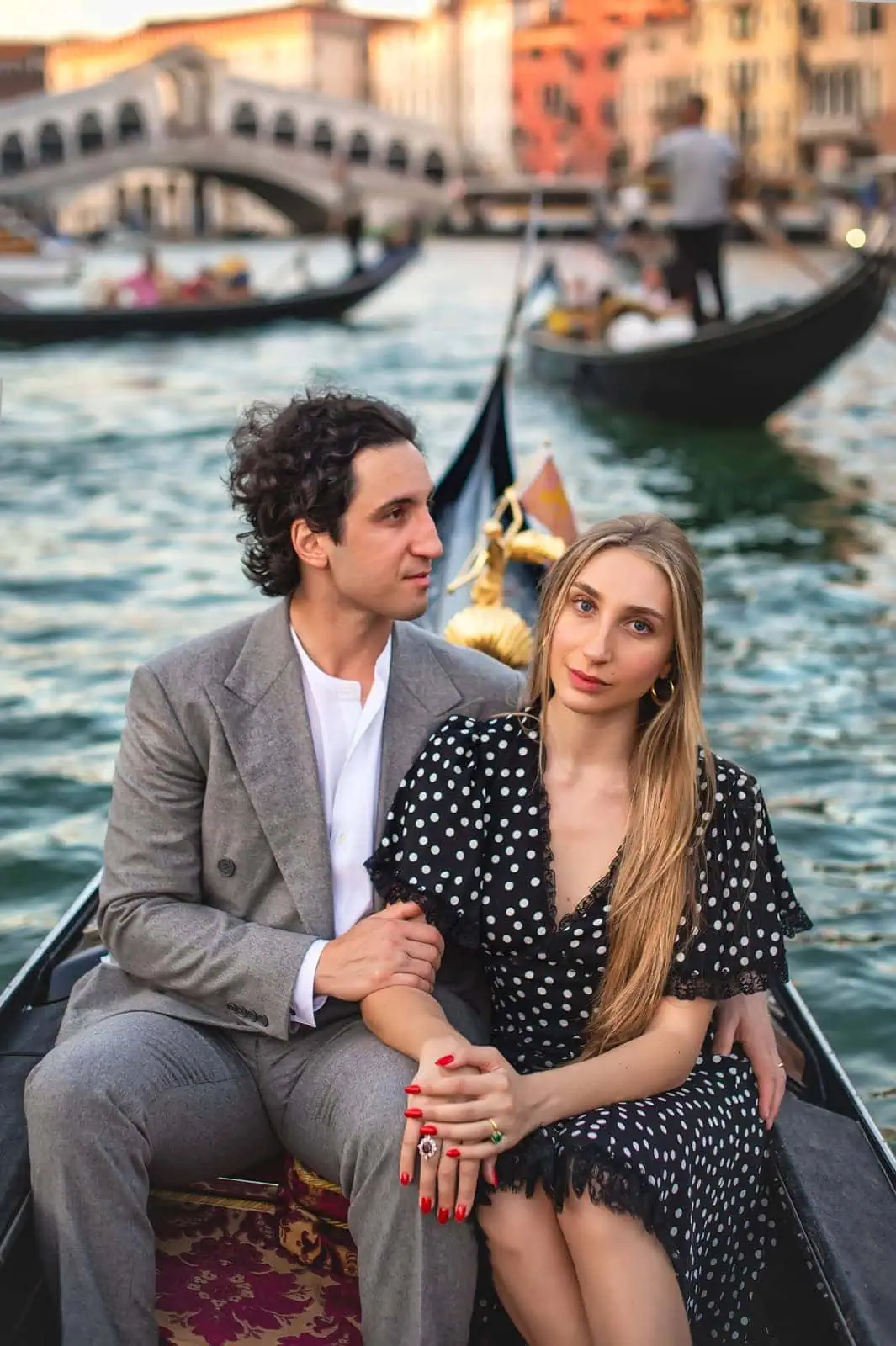


Venice is one of the most theatrical cities on earth, and a wedding here is not an ordinary event. The palaces are real, the canals are alive, and the architecture has been refining its sense of ceremony for five hundred years. What you wear does not simply reflect the occasion. It becomes part of the visual story of the day.
I have lived and worked in Venice for over fifteen years, photographing hundreds of celebrations across every venue, every season, and every level of formality. From intimate elopements in hidden courtyards to grand black-tie receptions inside Aman Venice’s frescoed salons. What I have learned is this: Venice rewards elegance and punishes impracticality. The city is beautiful but uncompromising. Its stone streets, its bridges, its tides, and its extraordinary light all demand that you dress with intention.
This guide gives you the complete, honest picture. Not just what looks good in theory, but what actually works when you are navigating Venice’s calli, boarding a water taxi in a gown, or attending a ceremony inside a church that has stood since the thirteenth century. You will also find something no other guide addresses: how your fabric and colour choices behave specifically in Venice’s light, which is unlike the light of any other city in the world.
In this guide
- Understanding Venice wedding dress codes
- Dressing for the Venetian seasons
- Acqua alta: the preparation no one mentions
- Footwear: the most important decision you will make
- How Venice light affects the way your attire photographs
- Water transport: gondolas, water taxis, and vaporetti
- Bride and groom attire: what Venice changes
- Wedding guest outfits for Venice
- Church ceremonies: what the rules actually are
- Venetian accessories worth knowing about
- Colours that work and ones to avoid
- What not to wear in Venice
- Frequently asked questions
Understanding Venice Wedding Dress Codes

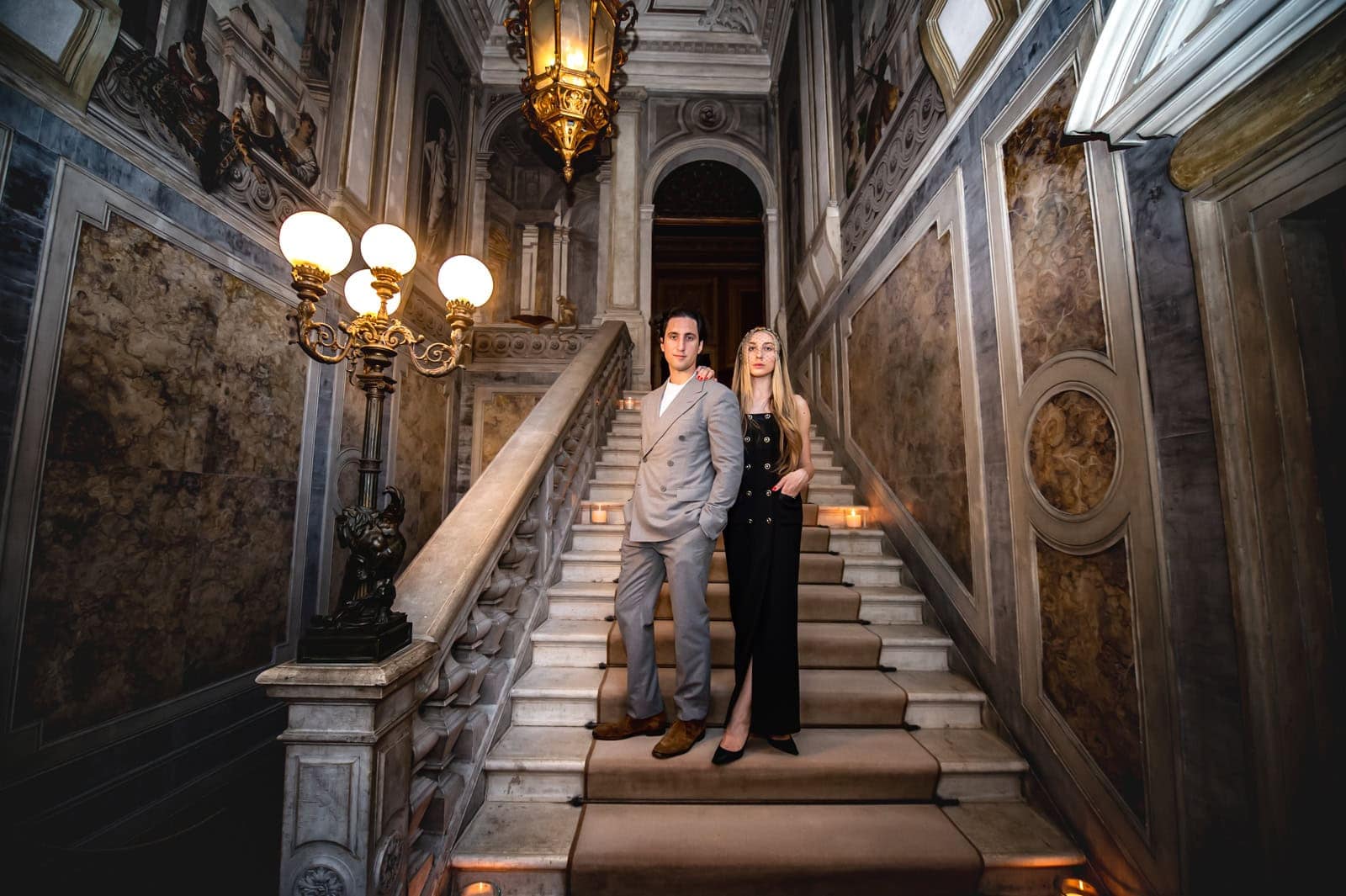

Venice weddings tend to skew formal. The city’s historic venues carry an inherent gravity that elevates expectations. Even at events described as relaxed, the surroundings themselves demand a certain standard of dress. The five levels below cover every type of celebration currently held in Venice, from a grand civil ceremony at Palazzo Cavalli to a barefoot reception on the shores of Torcello.
Black Tie
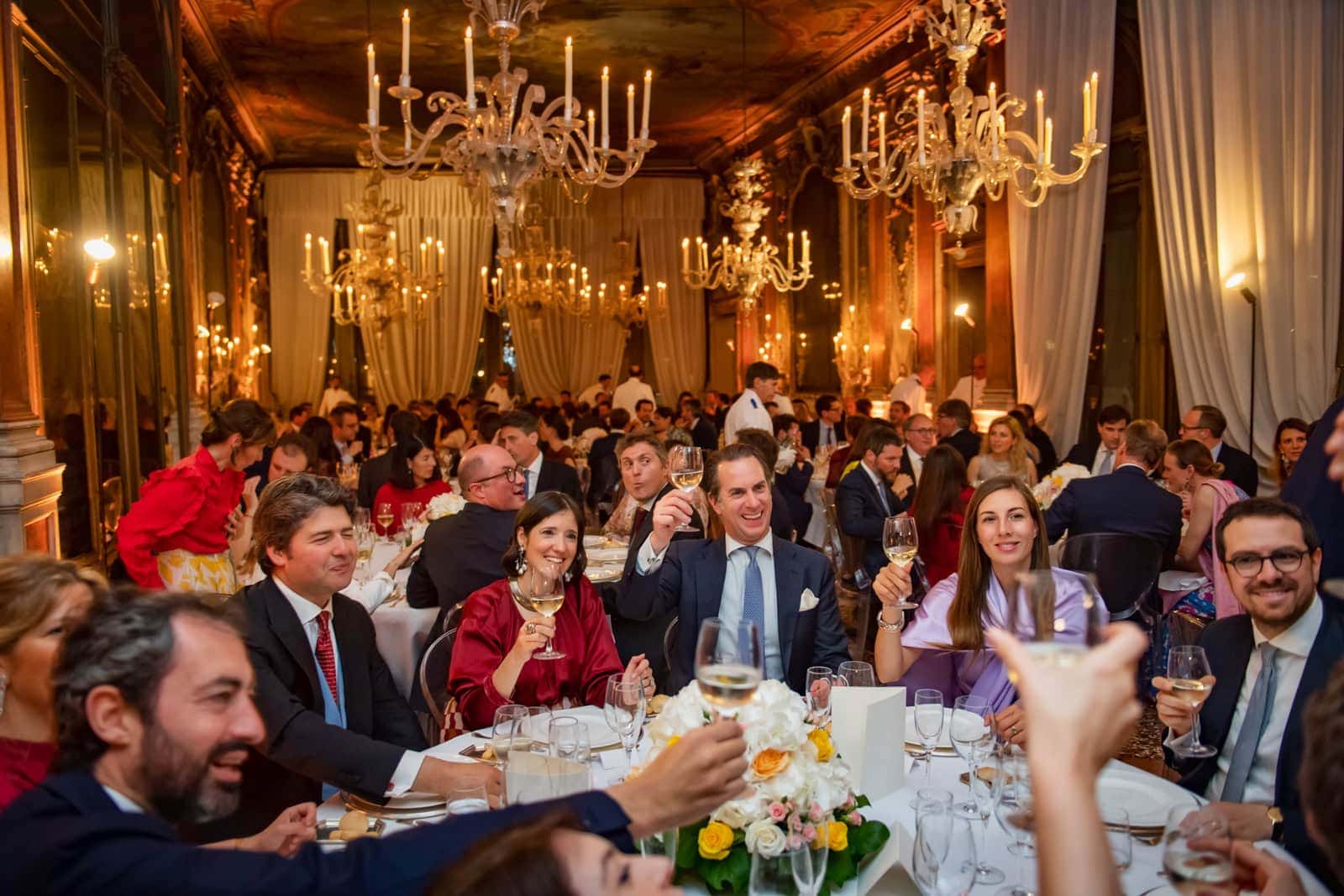
Full-length evening gowns for women. Tuxedos or white dinner jackets for men. Expected at venues such as Aman Venice (Palazzo Papadopoli), Ca’ Sagredo Hotel, and the Gritti Palace. These rooms contain Tiepolo frescoes and Murano chandeliers. Dress to match the scale of what surrounds you.
Formal and Evening Attire
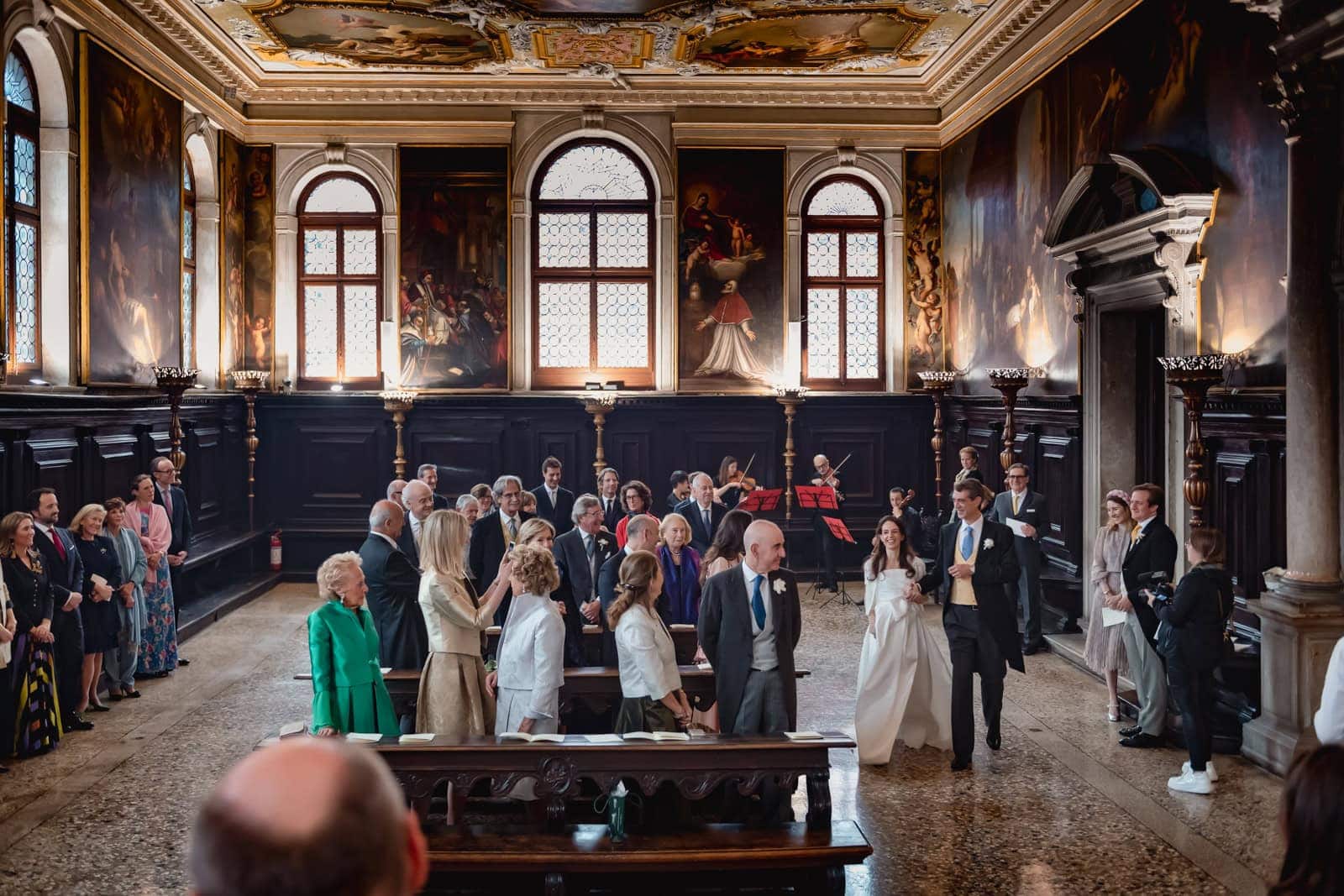
The most common Venice wedding dress code for destination celebrations. Women choose floor-length gowns, elegant midi dresses, or structured two-piece evening suits. Men wear a well-tailored suit in a dark or mid-tone colour with a tie. This is the correct level for venues such as Scuola Grande dei Carmini, Palazzo Cavalli, and most private Venetian palace receptions.
Cocktail and Semi-Formal
Midi or tea-length dresses for women. Never significantly above the knee at a Venetian venue. The setting will make you feel underdressed, and the door staff of many historic buildings will notice. Men wear a dark suit, dress shirt, and a tie or pocket square. Appropriate for smaller intimate celebrations in private courtyards and canal-side terraces.
Smart Casual and Destination Relaxed
Used occasionally for ceremonies on Venice’s outer islands: Lido, Torcello, or Burano, where couples want a lighter, sunlit atmosphere. Linen trousers and a linen shirt for men. A structured linen or silk dress for women. Even at the most relaxed Venice wedding, avoid anything that reads as genuinely casual. No denim, no sneakers, no resort beach wear.
A note on venue-specific expectations
Venice is unusual among European wedding destinations in that the venue itself communicates a dress expectation independently of the couple’s invitation wording. A wedding at a five-star historic palazzo carries a different implicit standard than a sunset ceremony on a private garden island. If the venue name appears on your invitation and you are unsure of the dress code, look it up. The venue’s own website will tell you everything you need to know about the standard it maintains.
Dressing for the Venetian Seasons
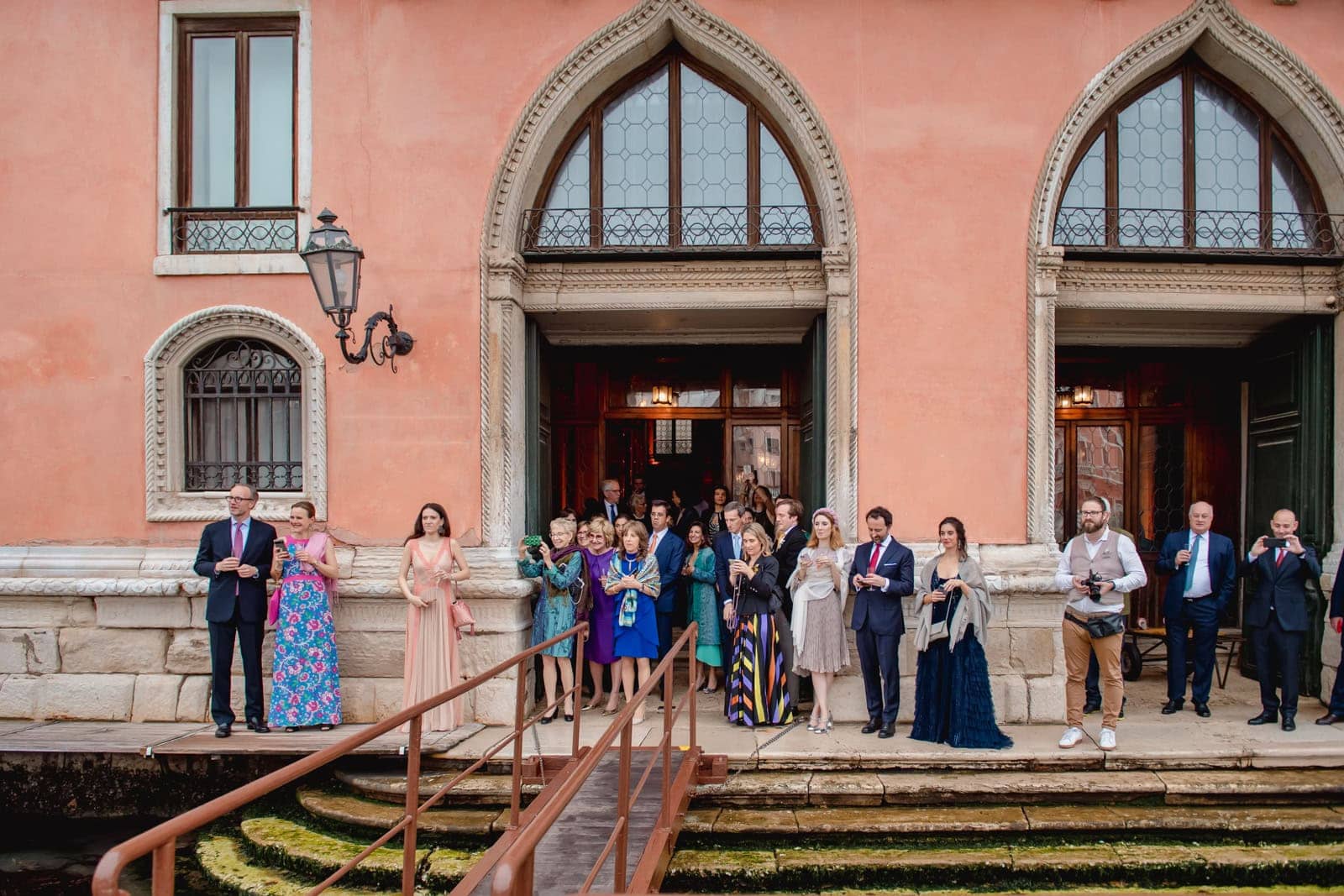

Venice has a continental climate tempered by the surrounding lagoon, which means summers are genuinely hot and winters are genuinely cold. Both extremes are sharper than most visitors expect. Choosing the wrong fabric for the season is one of the most common mistakes at destination weddings, and it shows in the photographs, in the faces, and in the comfort of everyone present.
Spring Weddings: April, May, and Early June
Spring is the ideal wedding season in Venice. Temperatures range from 16 degrees in early April to 26 degrees by June. The light is extraordinary: soft, warm, and even, with long golden hours in the early morning and late afternoon. Fabric choices for spring: chiffon, silk crepe, duchess satin for formal events, and lightweight structured linen for more relaxed celebrations. Bring a light pashmina for evening canal-side walks, where a breeze from the lagoon can drop the temperature quickly after sunset.
Summer Weddings: Late June, July, and August
Venice in high summer is beautiful and demanding. Temperatures regularly reach 32 to 34 degrees Celsius with high humidity rising from the lagoon. For women, floaty structured chiffon or silk organza moves with air rather than trapping heat. For men, a linen or tropical-weight wool suit in light grey, stone, or pale navy is far more comfortable than a standard worsted wool blend. Avoid very dark saturated colours in direct sun. They are both physically uncomfortable and visually heavy in strong summer light, which can flatten depth in photographs. Outdoor ceremonies in Venice typically happen before 10:00 in the morning or after 17:00 in the afternoon for precisely this reason. If your ceremony is at midday, anticipate and plan for the heat with fabric choices that breathe.
Autumn Weddings: September and October
September and October offer the most beautiful light in all of Venice. Warm, amber, low-angled, with dramatic cloud formations building over the lagoon in the late afternoon. Temperatures are comfortable, ranging from 18 to 24 degrees, and the crowds thin noticeably after early September. Fabric choices expand significantly: structured silk, heavy crepe, lightweight velvet, and layered looks all work beautifully. Bring a tailored coat for evenings. Temperatures drop fast after sunset from late September onward, and Venice in a cold autumn wind, particularly on the water, is unforgiving.
Winter Weddings: November through February
Winter Venice is extraordinary in its atmosphere. Mist rises from the canals, the calli are nearly empty, and the soft grey light turns every palazzo facade into a painting. It is also genuinely cold. Temperatures fall to between 0 and 4 degrees Celsius in January, with persistent dampness from the lagoon that makes the cold feel sharper than it looks on the thermometer. Velvet is the winter fabric of Venice. It drapes beautifully, photographs with depth and richness, and provides real warmth. Heavy silk, structured brocade, and layered looks with long-line coats also work well. For men: a heavy wool suit with a waistcoat, or a classic overcoat over formal evening wear. A well-chosen coat is as much a part of your outfit as the dress itself in winter. Invest in one that is both elegant and genuinely warm.
Acqua Alta: The Preparation No One Mentions

If your wedding falls between mid-October and the end of January, you need to know about acqua alta, Venice’s seasonal high-water phenomenon. It is not a disaster. It is part of the city’s life and a genuinely Venetian experience. But it requires specific preparation when you are dressed for a formal celebration, and the vast majority of travel guides and wedding blogs say nothing about it.
When acqua alta occurs, typically in the early morning hours, water rises across the lowest-lying areas of the city. Most frequently around Piazza San Marco, the Rialto, and the Dorsoduro waterfront. The depth ranges from 20 to 80 centimetres, and the city erects passerelle, raised wooden walkways, along the main routes. Smaller streets and bridge approaches will have water on the ground.
Most wedding venues in Venice are elevated above the standard flood zone and remain perfectly dry. The challenge is the walk to and from the venue. The practical solution: pack a pair of knee-high rubber boots that can fit over dress shoes or slip under the hem of a formal dress. In Venice these are available everywhere during the season, in styles ranging from plain black to deep burgundy and printed patterns. They have become genuinely fashionable. Midi and longer hemlines handle acqua alta far more gracefully than short dresses. Men with well-tailored trousers can simply roll the hem and walk with confidence.
One useful detail: the city of Venice publishes real-time acqua alta forecasts. If your wedding dates overlap with the October to January window, check the tide tables three to four days in advance. A forecast above 100 centimetres means most routes to central venues will require rubber boots. Below 80 centimetres, most areas remain entirely dry.
Footwear: The Most Important Decision You Will Make

Block heels between 5 and 6 cm are wide enough not to catch in stone joints, tall enough to feel genuinely dressed for a formal occasion, and stable enough to walk Venice’s bridges with confidence. They are the most versatile choice available for a formal Venice event.
Elegant wedge heels are slightly more casual in appearance but genuinely practical on uneven ground. Particularly good for outdoor ceremonies on terraces or campo settings where the surface varies.
Refined pointed-toe flats and ballet flats are perfectly appropriate at formal Venice events. The Venetians themselves wear them constantly, including at the most elegant private gatherings. Choose a leather sole rather than a rubber sole for a more polished visual finish.
Oxford brogues and Derby shoes for men in dark brown or black leather are both formally correct and practically excellent. Avoid very thin dress soles, which transmit the cold of stone floors in winter churches and palace interiors.
What to avoid
Stiletto heels above 7 or 8 cm: the fine point sinks directly into the joints between stone blocks, which is both uncomfortable and a genuine ankle injury risk on wet stone. Very high platform shoes: beautiful in photographs taken indoors, genuinely hazardous on bridge steps. Very flat thin-soled sandals in winter: the stone floors of Venice’s palaces and churches are cold, sometimes damp, and will chill you rapidly through a thin sole.
One practical approach used by many experienced guests: bring two pairs. A pair of elegant block-heeled shoes for the ceremony and photographs, and a pair of refined flats for the walking portions of the day. A structured evening bag holds a folded pair of flats easily. No one at the venue will notice the change, and you will end the day far more comfortably.
How Venice Light Affects the Way Your Attire Photographs


As a photographer who has spent fifteen years studying the light of this specific city, I can tell you that Venice’s light is not the same as the light of Paris, Tuscany, or the Amalfi Coast. It is reflected, diffused, and multiplied by water on all four sides. It behaves differently on fabric, on skin, and on colour. Knowing this before you choose your outfit gives you a meaningful advantage.
The Venice light effect on fabric
Silk and silk satin catch Venice’s golden-hour light and create a luminous, almost liquid glow in photographs. The canal water reflects upward light onto silk surfaces in a way that is genuinely unlike anything achieved in a studio setting. If you want photographs that look specifically and unmistakably Venetian, silk is the answer.
Velvet absorbs light rather than reflecting it, creating visual depth and a rich three-dimensional quality in photographs. In autumn and winter, when Venice’s light is low and raking, velvet reads as incredibly luxurious. In high summer under direct overhead sun, it can look heavy and flat.
Matte chiffon softens harsh light beautifully. In full summer sun, it eliminates the harsh reflections and blown highlights that affect satin and silk. It moves in the lagoon breeze in a way that creates natural motion in photographs, which is particularly valuable during outdoor portraits.
Heavily structured stiff fabrics such as raw dupioni or certain brocades can look rigid and architectural against Venice’s fluid canal lines. They work well in interior palazzo settings but can feel out of harmony with outdoor canal photography.
The worst fabric choice for Venice photography is anything with a synthetic sheen or polyester-based shine. In Venice, every surface reflects light: the canal water, the stone, the palazzo windows. A synthetic-sheen fabric picks up this ambient light and reflects it as a flat, white overexposed highlight. The fabric stops reading as a colour and simply glows white in the image. No amount of post-processing can fully recover it.
The Venice light effect on colour
Venice’s architecture is dominated by warm tones: terracotta, ochre, faded rose, Istrian pale stone, and the deep blue-green of the canal water. Deep jewel tones photograph with exceptional depth against this palette. Sapphire blue against a pale stone facade creates a natural complementary contrast. Burgundy against terracotta reads as rich and intentional. Ivory and champagne in late afternoon light appear to glow from within. Strong darks, midnight navy, deep charcoal, forest green, carry visual weight without competing with the surroundings.
The colours that tend to disappoint in Venice photography are very pale pastels in flat winter light, which can read as washed out, and very bright neons or saturated primaries, which feel at odds with the city’s aged and layered palette. Both can be made to work with the right timing and background selection, but they require more effort from the photographer and more precise lighting conditions to look their best.
Water Transport: Gondolas, Water Taxis, and Vaporetti

Venice is the only wedding destination in the world where the journey between venues is itself part of the ceremony. Arriving by gondola, departing by water taxi across the Grand Canal at sunset, boarding a private launch for a reception on one of the lagoon islands: these moments will be photographed and remembered. They also impose specific physical requirements on what you are wearing that no other guide addresses.
Boarding a gondola
Boarding a gondola from a stone fondamenta requires stepping down into a moving boat from an uneven stone step, often with no handrail. A narrow silhouette dress or an A-line gown boards gracefully. A wide ball skirt or a stiff structured skirt is genuinely challenging and will require significant assistance. Very high heels make gondola boarding dangerous on wet stone steps. The gondolier will assist, but the architecture of the step and the movement of the water impose limits that fashion cannot entirely overcome.
Water taxis and private launches
Private water taxis and launches have more deck space than gondolas and are easier to board in formal attire. A full-length gown with a moderate train boards a private launch without difficulty if you gather the hem briefly. The exposure to wind and lagoon spray is significant on an open launch at speed. Long veils, wide-brimmed hats, and very light sheer fabrics will need to be managed on the water. Consider a wrap or structured jacket for any boat journey lasting more than a few minutes.
Vaporetti
If any part of your day involves the public vaporetto water bus to reach an outer island, be aware that boarding and disembarking involves a step across a gap between dock and deck over water, sometimes with a significant crowd. A long train or very wide skirt becomes impractical. Flat shoes are strongly advised for any vaporetto journey.
Bride and Groom Attire: What Venice Changes


Everything said about dress codes and fabrics applies to couples as much as guests. But Venice introduces specific considerations that brides and grooms should plan for explicitly, beyond the standard guidance that applies to any wedding.
For the bride: train length and Venice logistics
Venice is genuinely challenging for a long cathedral train. The calli are narrow, often only wide enough for two people to pass side by side. Bridge steps require lifting any trailing fabric, which works for a short chapel sweep but becomes cumbersome with a two-metre cathedral train. For gondola boarding and disembarking, even a modest chapel train needs careful management.
The wedding dress silhouettes that work beautifully in Venice: a sweep train just grazing the floor, a short chapel train of 30 to 50 centimetres, or a detachable train that can be removed for the streets and restored for the venue interior. Many Venice brides opt for clean sculptural silhouettes: fitted silk crepe gowns, structured A-line shapes, or fluid column dresses that read as genuinely luxurious without the logistical challenge. A dramatic cathedral veil flowing in the salt-air lagoon breeze creates more visual impact in photographs than a long ground train in most Venice settings.
For the groom: suit weight and layering
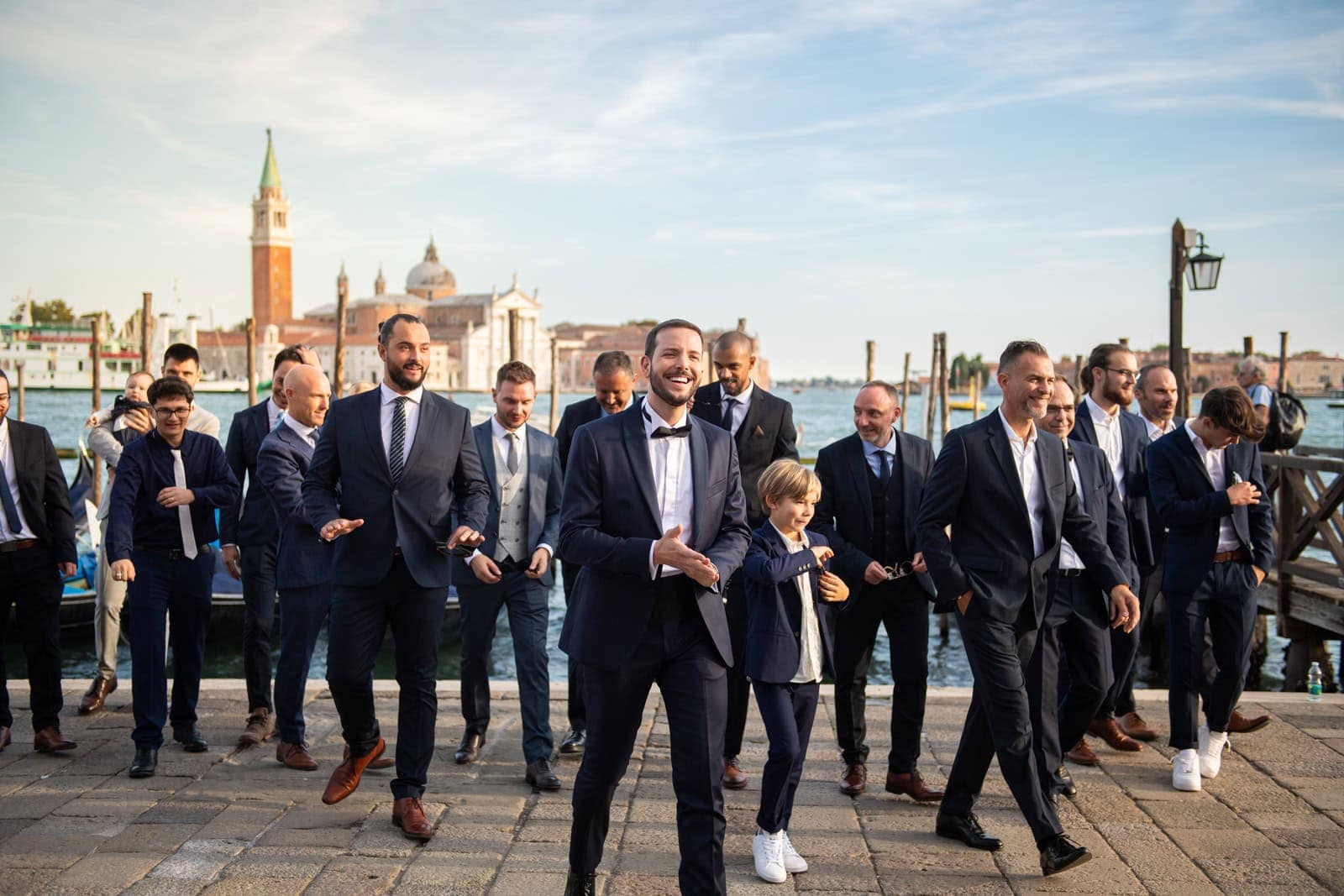
In spring and autumn, a lightweight wool or fresco-weave suit in navy, charcoal, or warm grey photographs with depth and elegance against Venice’s stone and water. In summer, a linen suit or a tropical-weight wool in cream, pale grey, or stone reads as appropriately adapted to the heat without losing formality. In winter, a heavier tweed or flannel in a jewel tone, deep burgundy, bottle green, or midnight blue, is both warm and visually striking against Venice’s muted winter palette. A well-chosen waistcoat extends the warmth of any winter suit considerably without requiring an overcoat inside the venue. Take a look to my wedding portfolio for more inspiration.


Wedding Guest Outfits for Venice


As a guest, your role is to dress elegantly without competing with the couple, and in Venice, that is a high but entirely achievable standard.
Women’s guest attire
Floor-length and midi dresses are the safe, beautiful choice for most Venice wedding guest outfits. Tea-length, meaning mid-calf, also works well. Very short hemlines feel at odds with the architectural gravitas of Venice’s venues and churches and will draw attention for the wrong reasons. In terms of silhouette, structured wrap dresses, fitted A-line gowns, and softly draped column dresses all translate beautifully to both photographs and movement through Venice’s streets. Layering works very well in Venice: a structured silk top with wide-leg palazzo trousers, or a fitted bodice gown with an embroidered evening jacket.
Men’s guest attire
A well-tailored suit is the foundation. Dark navy, charcoal, and deep slate are the most versatile choices. They photograph well against both the pale Venetian stone and the dark interior walls of historic palaces. A pocket square, a tie, and polished leather shoes complete the look. For black-tie events, a classic dinner suit or a slim-cut tuxedo with a white shirt is correct and timeless. Avoid light grey or cream suits in winter, as they can read as out of season against Venice’s autumnal palette and tend to look cold in low winter light.
Church Ceremonies: What the Rules Actually Are


Venice is home to some of the most beautiful religious spaces in the world. The Basilica dei Frari with its Titian altarpieces. San Zaccaria with its exquisite Giovanni Bellini. Santa Maria della Salute dominating the mouth of the Grand Canal. Catholic weddings in Venice frequently take place in these buildings, and they carry specific dress requirements that are enforced without exception.
Covered shoulders are mandatory for all guests entering any Venetian church. This is not a suggestion. It is enforced at the entrance. Women wearing strapless or sleeveless dresses must bring a shawl, lace bolero, or structured jacket. Men in sleeveless shirts will not be admitted. A Burano lace shawl is the most beautiful and most locally appropriate solution. Delicate, ivory, handmade on the island that has produced this craft since the sixteenth century. It solves the shoulder-covering requirement entirely and doubles as a meaningful accessory for the rest of the celebration.
Knees should also be covered during the ceremony. Dresses below the knee already satisfy this requirement. If you are wearing a shorter dress, plan to sit with a light wrap or pashmina across your lap during the seated portions of the ceremony.
One detail that surprises many visitors: the interiors of Venice’s churches are typically cool even in the height of summer. The thick stone walls regulate the temperature to a level far below the outdoor heat. Bring a layer regardless of the season. You will be grateful for it both for practical warmth and for the shoulder-covering requirement.
Venetian Accessories Worth Knowing About


Venice has its own craft tradition, centuries old and still alive. Incorporating it into your wedding attire in Venice is one of the most considered and genuinely personal choices you can make as a guest or as a couple celebrating here.
Murano glass jewellery: The island of Murano has produced glass of extraordinary quality since the thirteenth century, when the Republic of Venice moved all glassmakers to the island to protect both the city from fire and the craft secrets from competitors. Deep-teal, cobalt, amber, and rose Murano glass beads and pendants are available across Venice in every quality level and price range. A genuine Murano glass necklace or earrings add both colour and narrative to any outfit. They are wearable proof of where you were. Look for the Vetro Artistico Murano trademark to distinguish authentic pieces from imported imitations.
Burano lace: Burano, the island of painted houses an hour across the lagoon, is the traditional home of Venetian needle lace, known as punto in aria, meaning stitch in the air. A genuine Burano lace shawl is an heirloom-quality accessory: delicate, ivory, and extraordinarily fine. It resolves the church shoulder-covering requirement and adds a layer of authentic Venetian story to the day. Be aware that machine-made lace is sold everywhere in Venice under the Burano name. Genuine handmade Burano lace is sold only at the Museo del Merletto on Burano and at a small number of verified artisan shops. The difference in quality and in price is significant.
Venetian leather goods: Several Venetian artisans still produce small evening clutches and accessories by hand in the city. A hand-stitched leather clutch in burgundy, cognac, or deep olive is a beautiful and lasting alternative to a generic evening bag, and it will outlast the occasion by decades.
A note on Venetian masks: they are occasionally incorporated at themed Carnivale receptions in February and are entirely appropriate in that context. They are not appropriate accessories at standard wedding celebrations at any other time of year.

Colours That Work and Ones to Approach With Care
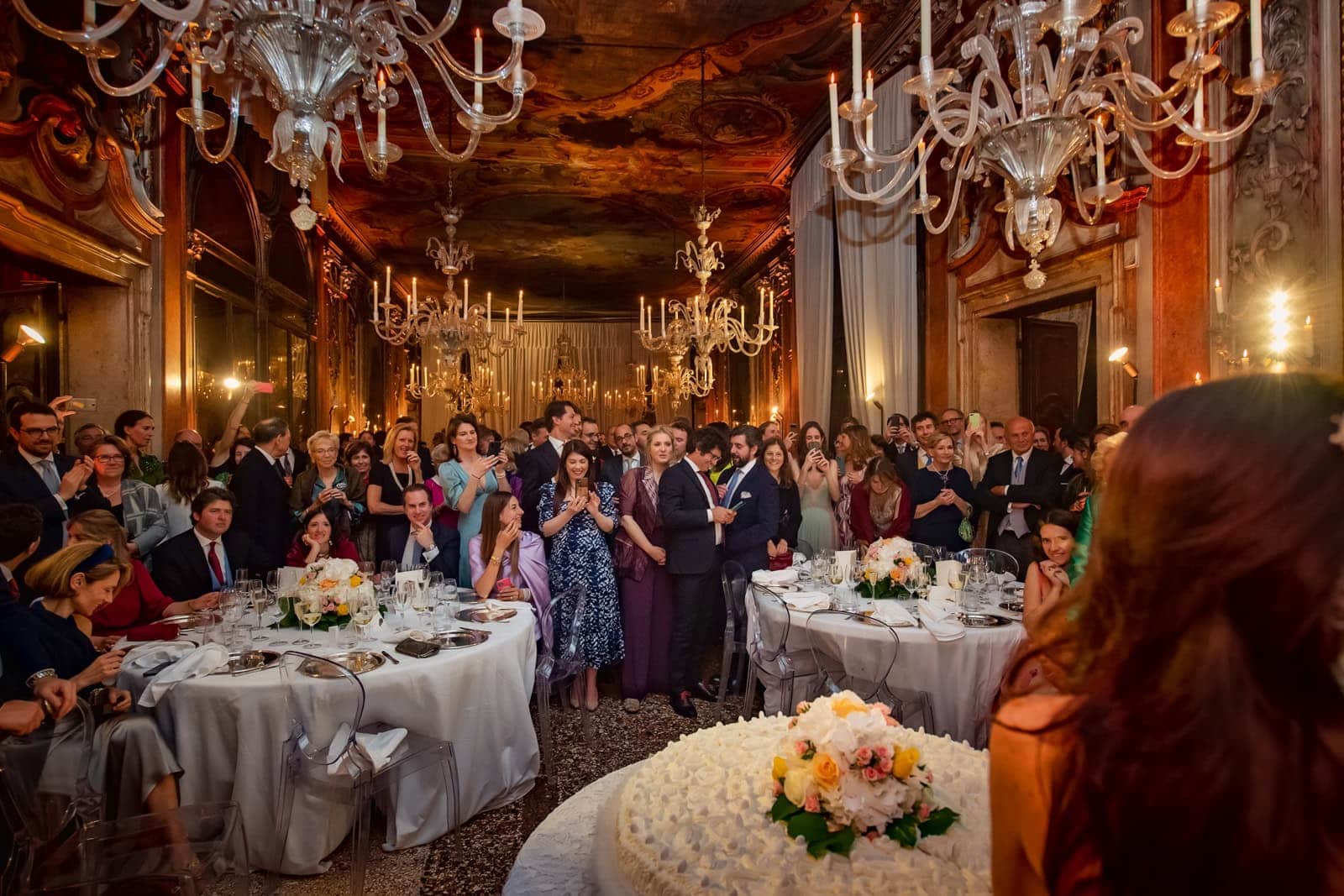
Venice’s architecture is dominated by terracotta, ochre, faded rose-pink, pale Istrian stone, and the deep blue-green of the canal water. This palette is both forgiving and specific: certain colours look extraordinary against it, and others either disappear into it or create an unintended visual clash.
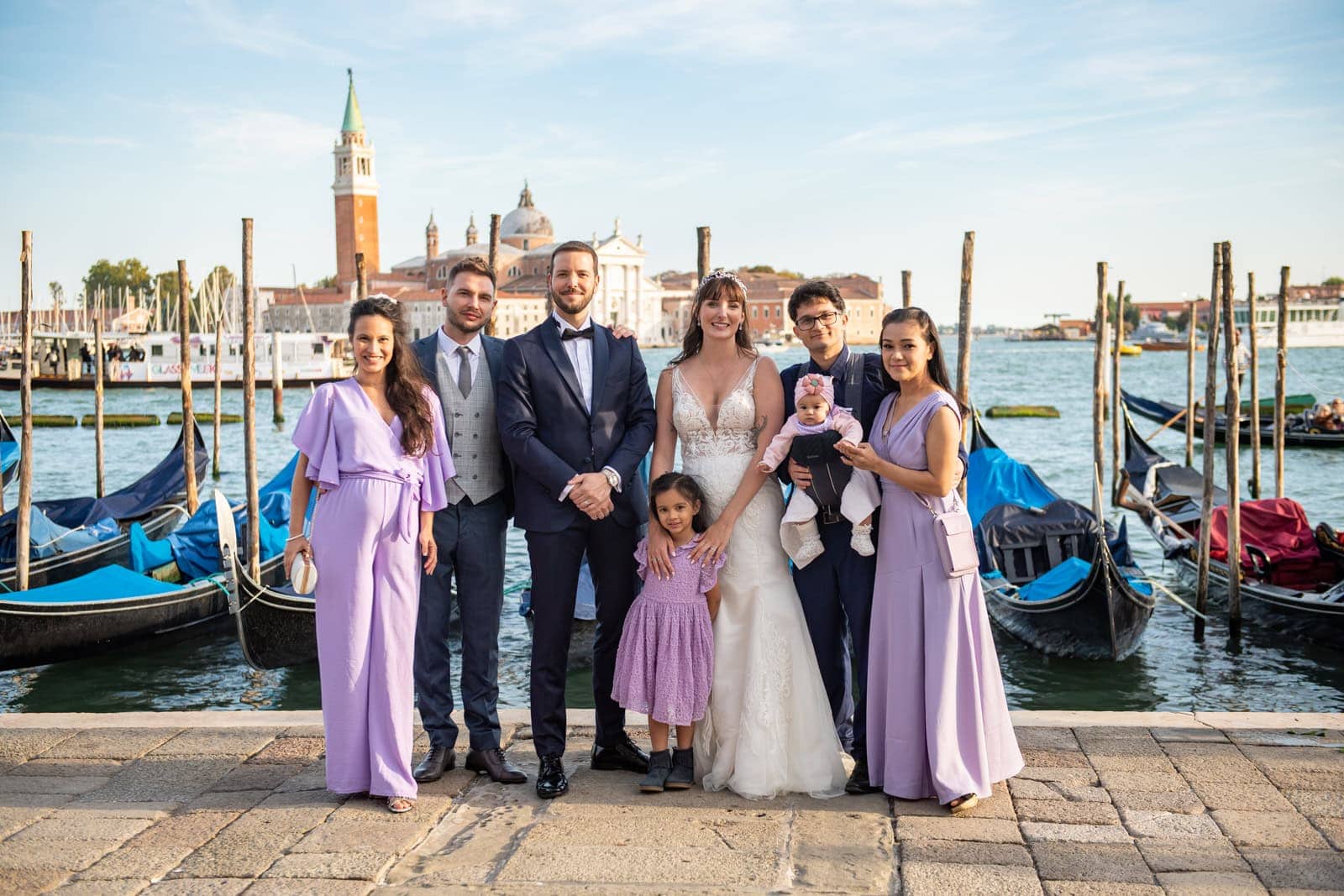
Colours that photograph beautifully in Venice: deep jewel tones against the pale stone, particularly sapphire blue, emerald green, burgundy, and amethyst. Warm dusty rose and blush against terracotta facades. Ivory and champagne in the golden late-afternoon light, where they appear to glow from within. Strong architectural darks, midnight blue, deep navy, charcoal, forest green, which carry visual weight without competing with the surroundings. Rich copper and warm bronze tones, which echo the city’s aged metal lanterns and church fixtures.
Colours to approach with care: pure white, which is reserved for the bride and is also genuinely difficult to keep clean in Venice’s streets. Neon or very highly saturated brights, which can feel discordant against Venice’s aged palette. Very pale pastels in overcast winter light, which can photograph as washed out. Light yellows and lime greens, which can cast an unflattering reflection against the greenish canal water in certain lighting conditions.
Black deserves a direct note. Traditionally avoided at weddings in some Italian cultural contexts, it is now entirely acceptable at the majority of modern Venice destination celebrations and photographs with striking elegance against the city’s pale stone and golden light. If you are uncertain, check with the couple. In the absence of guidance from them, black at a formal or semi-formal Venice wedding is a safe and genuinely beautiful choice.
What Not to Wear in Venice for a Wedding

A direct and honest list drawn from fifteen years of observation across hundreds of Venice celebrations.
Stiletto heels above 7 cm: the cobblestones will win without exception. The risk of ankle injury on wet stone is real.
Very short hemlines: anything significantly above the knee reads as casual against the grandeur of Venice’s interiors. It will also create a practical issue at the door of any church.
White or ivory as a guest: standard wedding etiquette everywhere, but observed more strictly in Italy than in many other countries.
Strapless dresses without a cover-up: beautiful in photographs taken inside the venue, but impractical the moment any part of the day enters a church, a traditional palazzo, or a formal outdoor setting. Always bring something.
Synthetic sheen fabrics: as covered in the photography section, anything with a polyester-based shine reflects Venice’s ambient light as a flat white highlight in photographs. The colour disappears and the fabric simply glows white. This cannot be recovered in post-processing.
Very wide ball skirts: on a gondola, in a water taxi, or moving through the narrow calli, a very wide skirt becomes a practical problem for everyone around you. Beautiful for the venue interior, genuinely challenging for everything between venues.
Tourist-coded clothing: shorts, casual sandals, athletic wear, resort-casual pieces. These feel acutely out of place at any Venice wedding, and the Venetians in the surroundings will notice. The city’s residents dress carefully as a cultural standard. Guests at a Venice celebration are expected to meet or exceed that standard.


Frequently Asked Questions
Most weddings in Venice follow a formal or black-tie dress code, reflecting the city’s historic venue standards. Women typically wear floor-length gowns or elegant cocktail dresses. Men wear suits or tuxedos. Always check your invitation wording, and when in doubt, dress more formally rather than less. Venice venues such as Aman Venice, Ca’ Sagredo, and Palazzo Cavalli have high elegance standards.
High stiletto heels are not recommended for a Venice wedding. The Istrian stone pavements, uneven calli, and bridge steps make thin heels impractical and genuinely risky on wet stone. Block heels between 5 and 6 cm, elegant wedges, or refined pointed-toe flats are the best choice. Many guests bring elegant flats in a small bag and switch to heels only inside the venue itself.
For a summer Venice wedding between June and August, choose lightweight breathable fabrics: chiffon, silk organza, or linen. Opt for lighter colours and looser silhouettes. Venice in July and August regularly reaches 32 to 34 degrees Celsius with high humidity. A small fan and a light wrap for air-conditioned venue interiors are both practical and worth packing.
For a winter Venice wedding between November and February, prioritise warmth without sacrificing elegance. Velvet, heavy silk, and structured wool blends work beautifully in this season. A tailored coat or embroidered evening wrap is essential for moving between venues. If your dates fall between October and January, also prepare for acqua alta by packing knee-high rubber boots you can wear over dress shoes.
All Venetian churches require covered shoulders for everyone entering, without exception. Women must bring a shawl, lace bolero, or structured jacket. A Burano lace shawl is both a practical solution and an authentically Venetian accessory. This rule applies equally to guests and the bridal party at any religious wedding ceremony in Venice.
Acqua alta is Venice’s seasonal high-water phenomenon, most frequent between October and January. Water rises in low-lying areas of the city to depths of 20 to 80 centimetres. Most wedding venues remain dry, but walking routes to them may be temporarily flooded. Pack foldable rubber overshoes or knee-high rubber boots. Midi and longer hemlines handle acqua alta far more gracefully than short dresses. Check the city’s official tide forecast at comune.venezia.it/maree for your specific dates.
Silk and silk satin catch Venice’s famous golden-hour light and create a luminous glow that is unique to this city’s reflected water light. Velvet adds visual depth and drama. Matte chiffon softens harsh summer sun. The worst fabric for Venice photography is anything with a synthetic sheen, which reflects canal glare as a flat white highlight that eliminates all colour in the image.
A very long cathedral train is logistically challenging in Venice. Narrow calli, bridge steps, and gondola boarding all require careful management of trailing fabric. Most Venice brides choose a sweep train or a short chapel train. A cathedral veil flowing in the lagoon breeze creates more visual impact in photographs for most Venice settings than a very long ground train.
Planning a Wedding in Venice?

Getting the attire right is one part of the picture. The other is working with a photographer who knows exactly where the light falls at 7:30 in the morning, which calli stay quiet until 9:00, and how to read the weather off the lagoon to find the best frame for every moment of the day.
Fifteen years of that specific knowledge go into every wedding I document. If you are considering Venice for your celebration and want to understand how photography fits into the day, visit the Venice wedding photography page or contact me directly.
You can contact me via WhatsApp for a direct conversation
or use the contact form to receive a detailed reply.