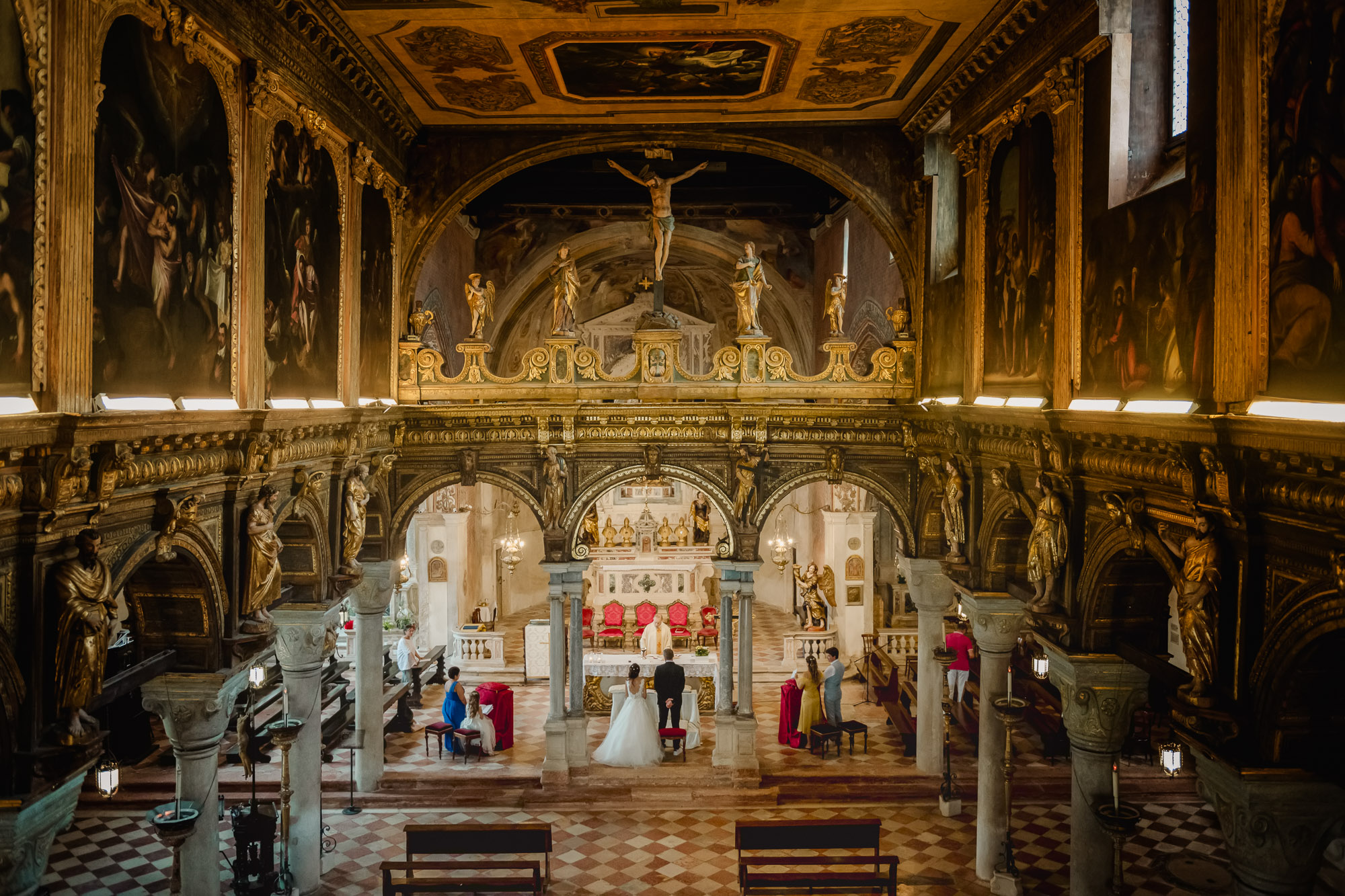
A religious wedding in Venice is a solemn and deeply symbolic ceremony shaped by centuries of tradition, architecture, and precise liturgical rules. Unlike civil or symbolic ceremonies, church weddings in Venice follow a fixed structure that allows little flexibility and requires a respectful, fully prepared approach from everyone present, including the photographer.
Every church imposes its own constraints, and those constraints are non-negotiable. Movement inside the ceremony space is restricted to specific areas agreed with the officiant in advance. Flash photography is limited or entirely forbidden in most Venetian churches, which means that all images must be produced using available light, requiring both technical preparation and a deep familiarity with how each interior behaves at different hours. Shooting positions during key moments are fixed, and the photographer cannot reposition during the ceremony without disturbing the liturgy.
These constraints are not obstacles. When understood in advance and integrated into the photographic strategy, they produce a visual record that is entirely coherent with the sacred character of the ceremony. The limitations of the space become the grammar of the images.
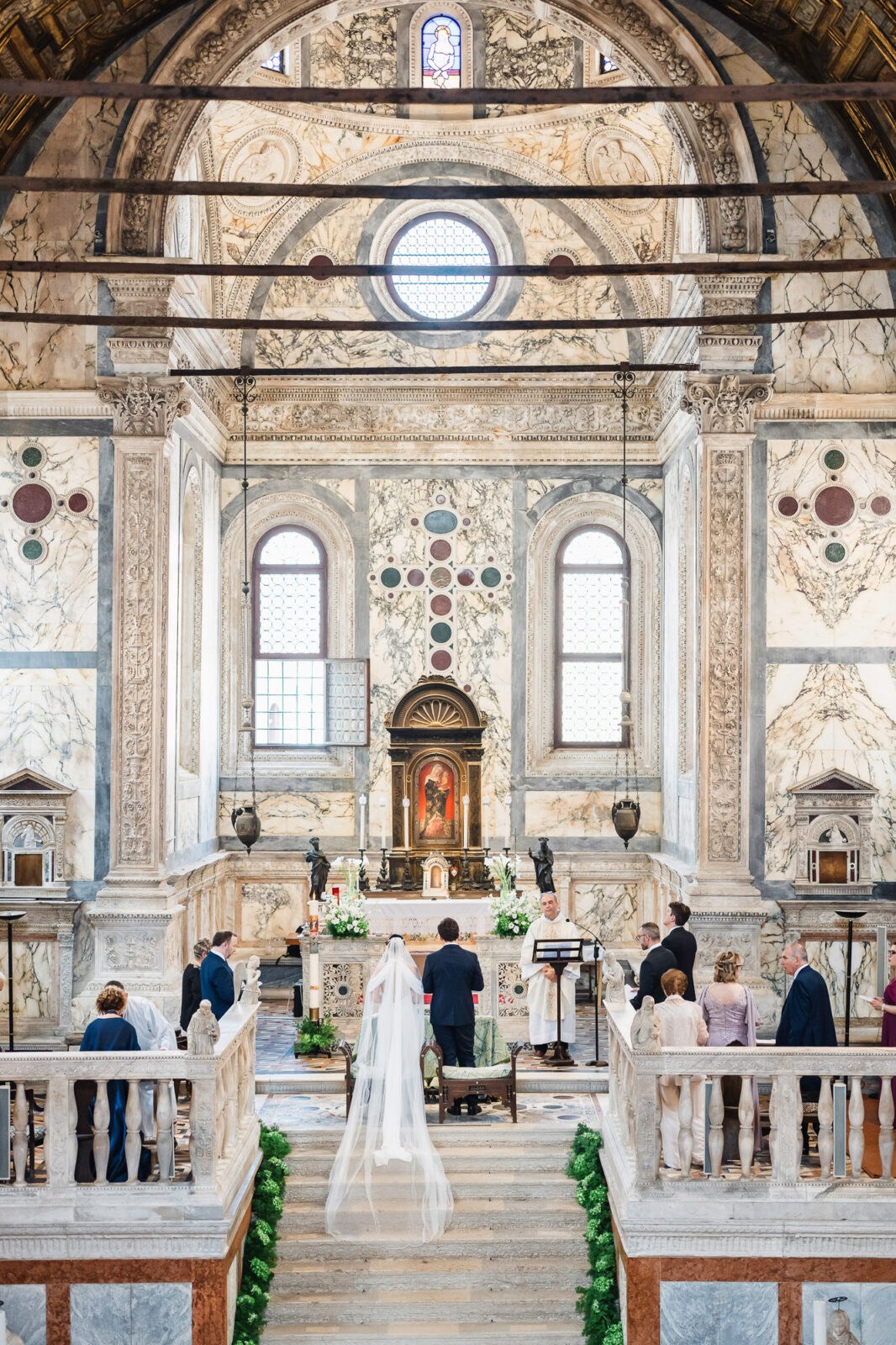
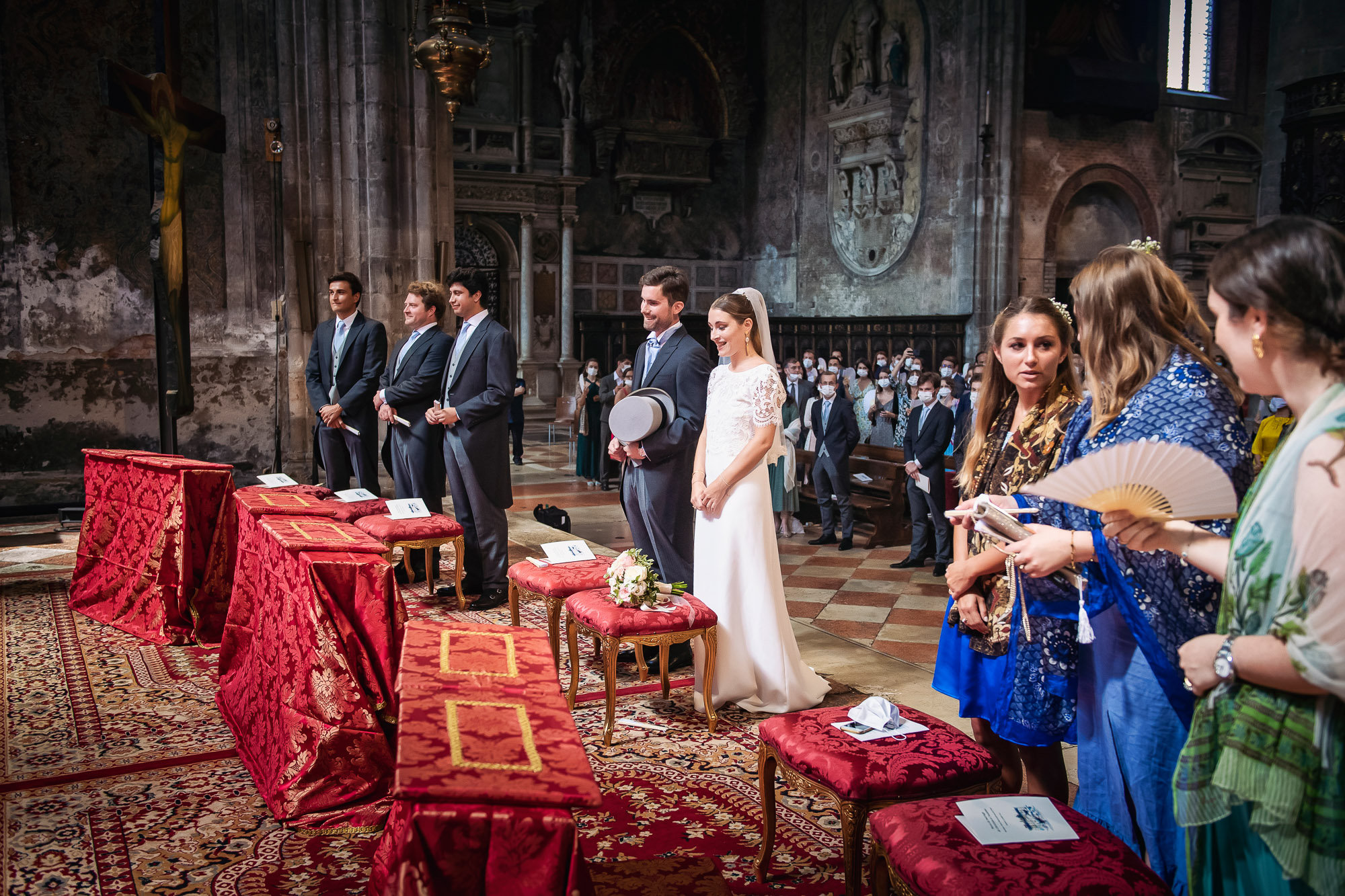
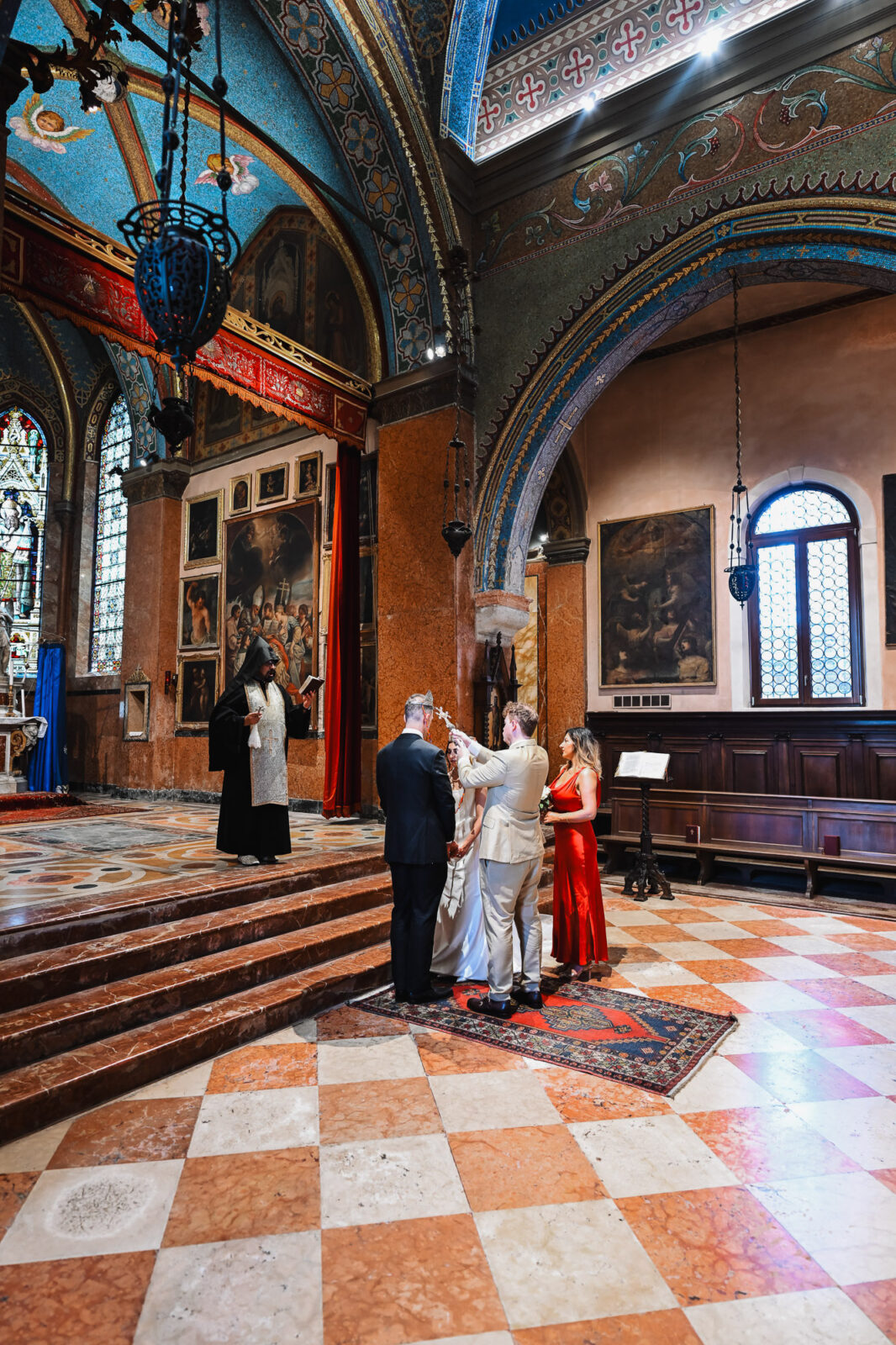
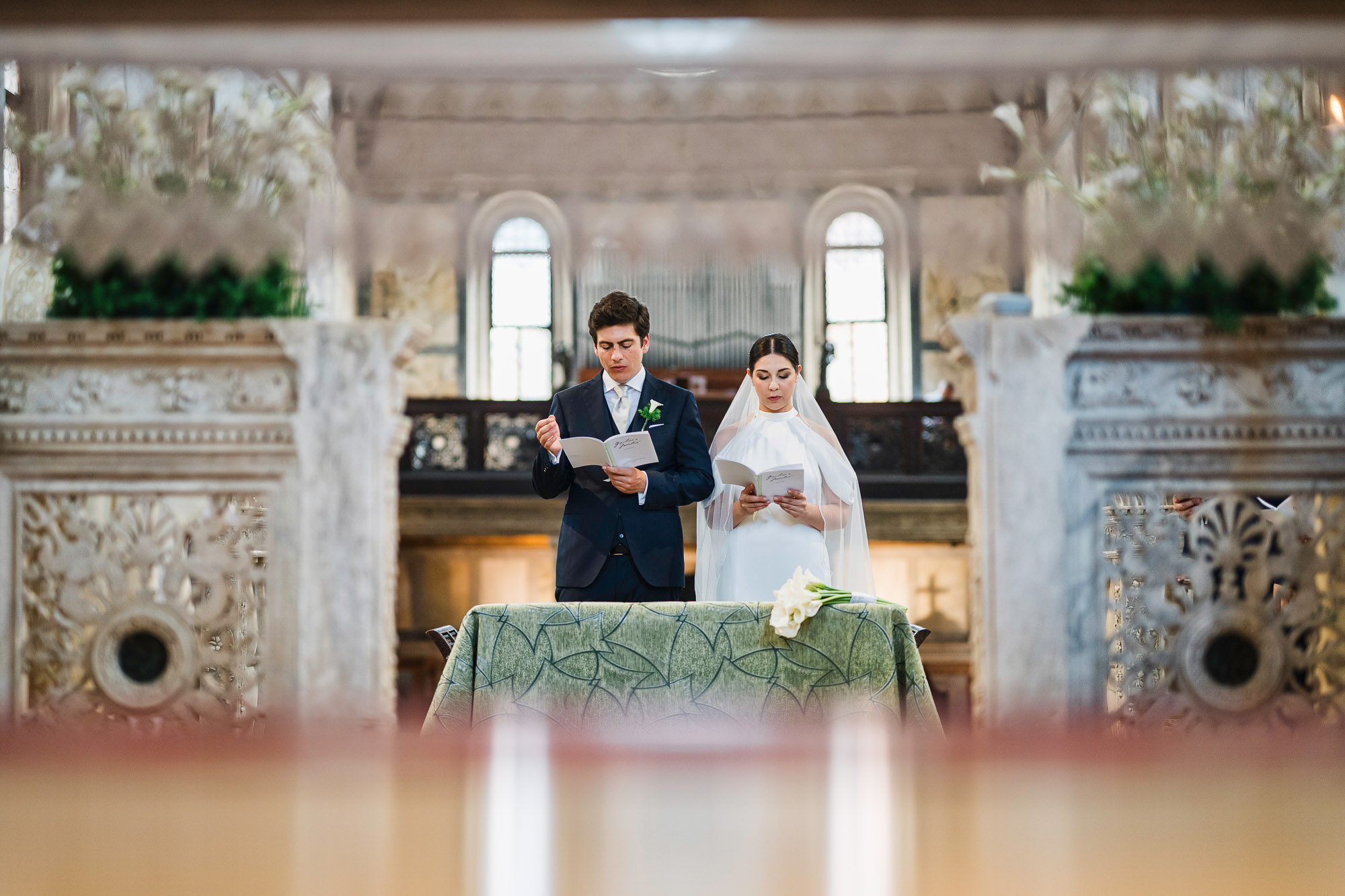
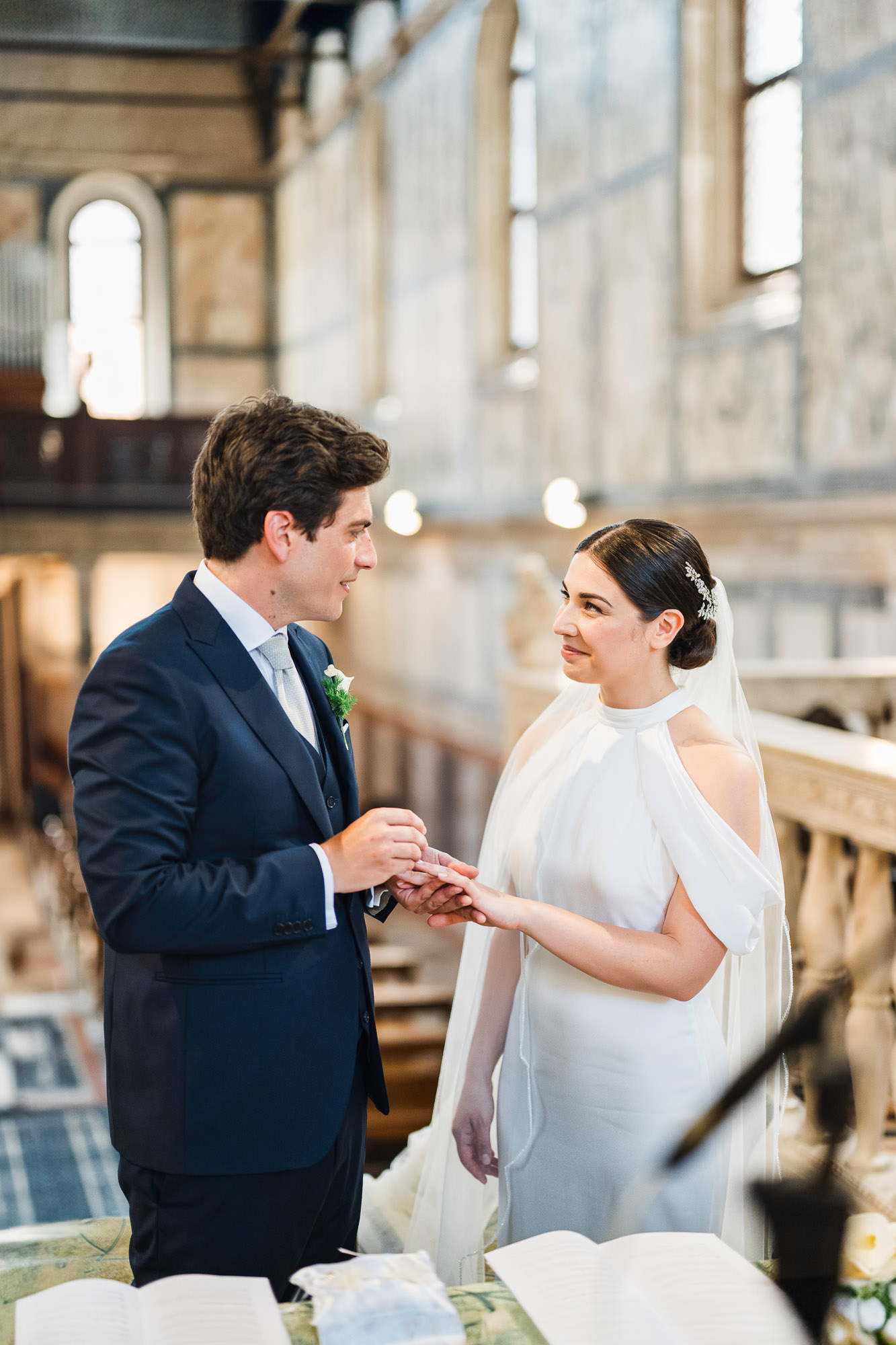
Religious ceremonies in Venice include moments that occur once, in sequence, and without pause. The entrance of the couple, the exchange of vows and rings, the liturgical blessings, the Eucharist in Catholic ceremonies, the crowning in Orthodox rites, the recessional. Each of these moments is structurally defined by the rite itself. None of them can be recreated or repeated after the fact.
What this means for a religious wedding photographer in Venice is that anticipation replaces reaction entirely. I know from experience precisely where to position myself before the entrance of the couple, which angle captures the exchange of rings in the available light of each specific church, and how much time separates one liturgical moment from the next in each rite. This operational knowledge is not something that can be acquired on the day. It is the result of years of work inside these specific spaces.
The silence that religious ceremonies impose also changes the photographic approach fundamentally. I work with equipment specifically selected for its acoustic discretion. The camera does not intrude on the atmosphere it is meant to document.

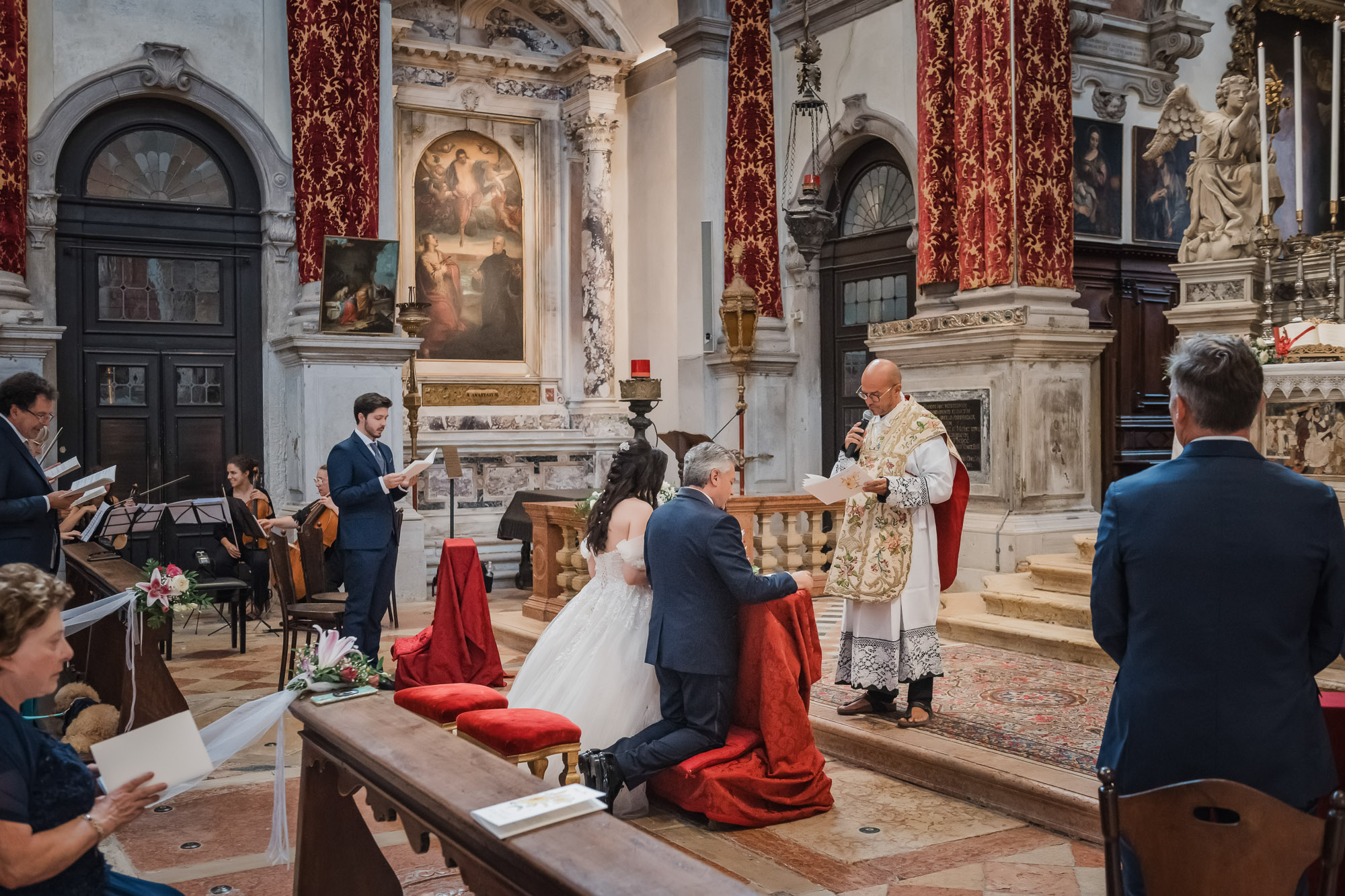
Catholic Weddings in Venice
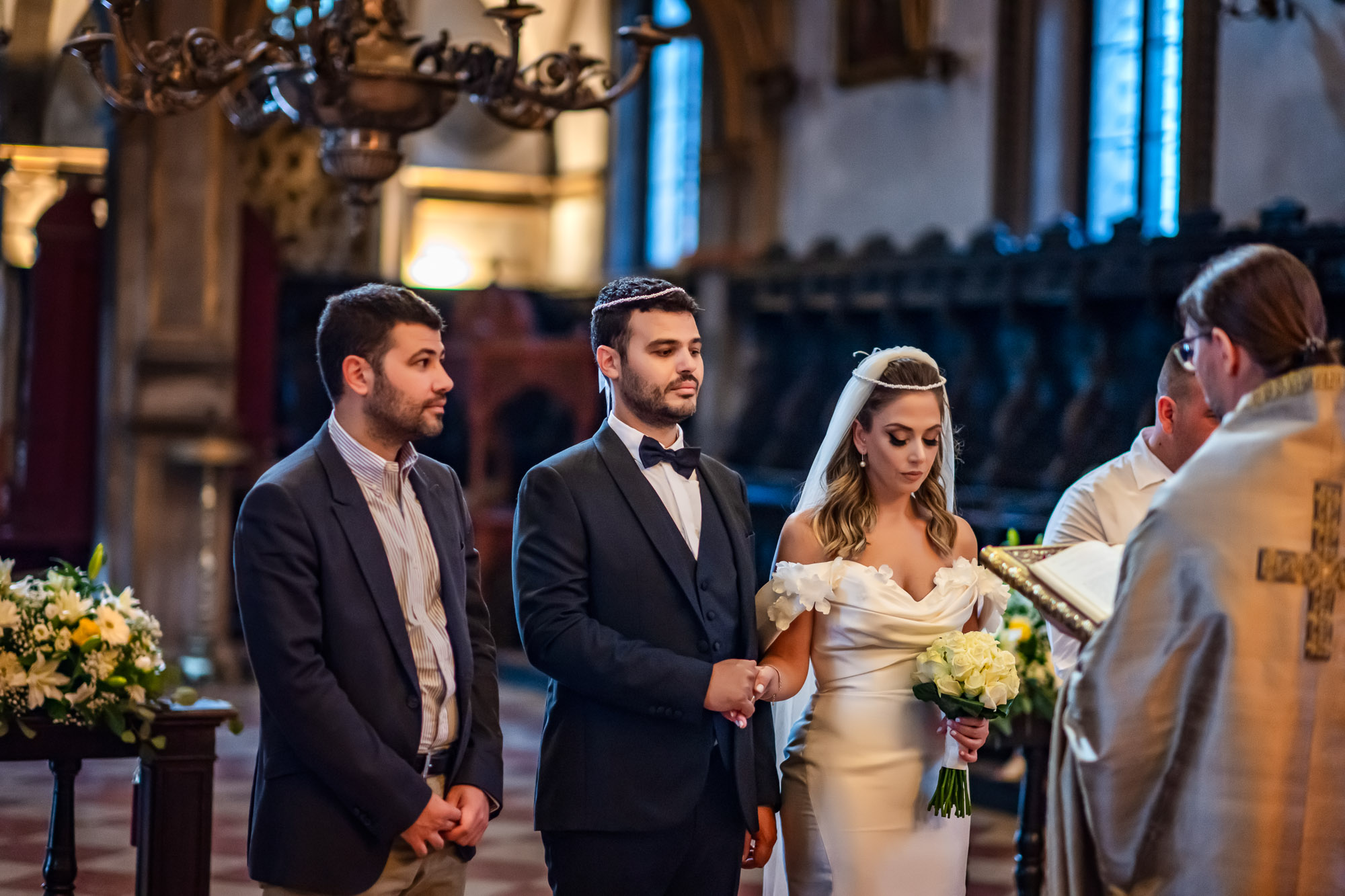
Greek Orthodox Weddings in Venice
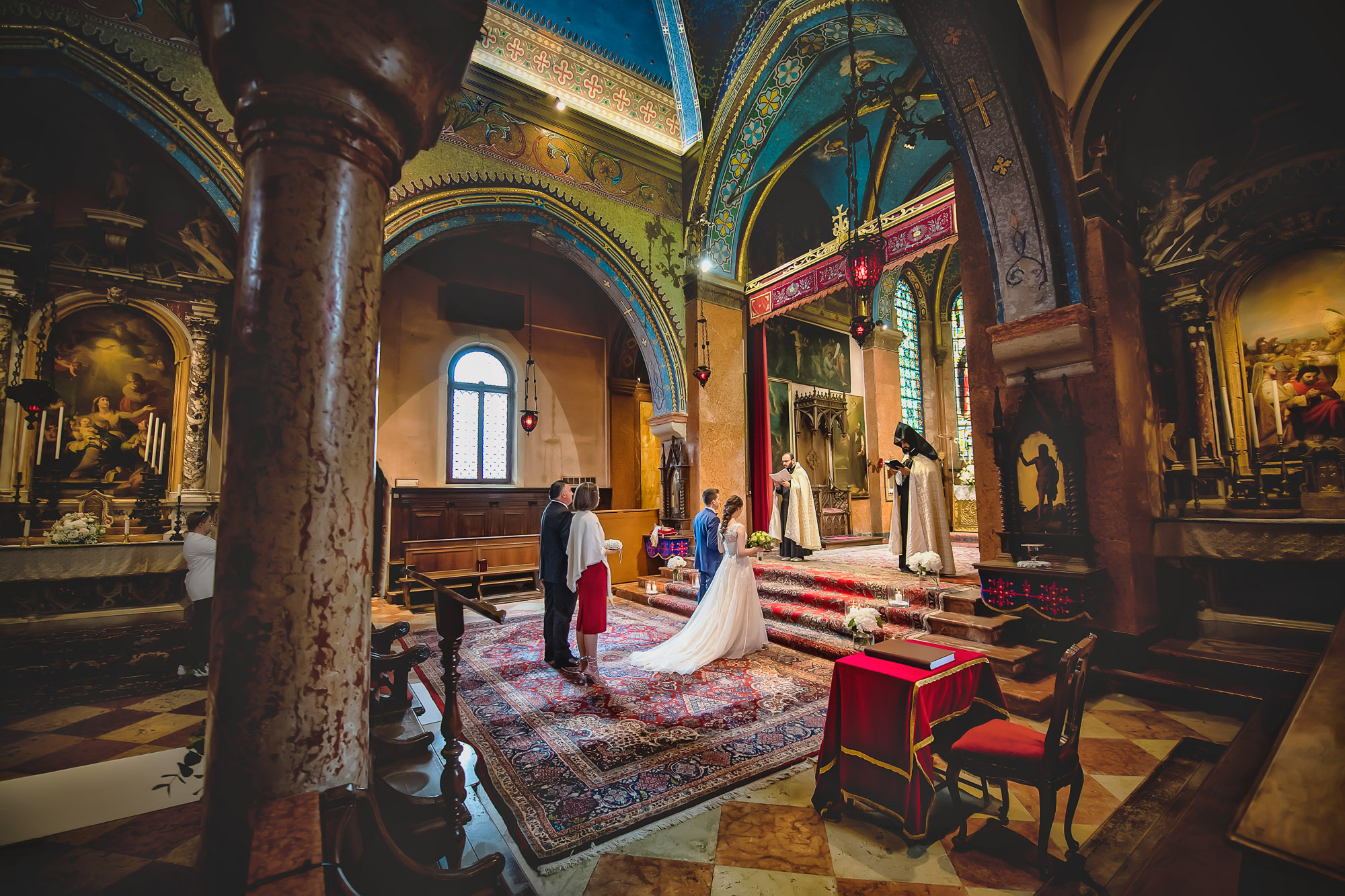
Armenian Apostolic Weddings at San Lazzaro degli Armeni
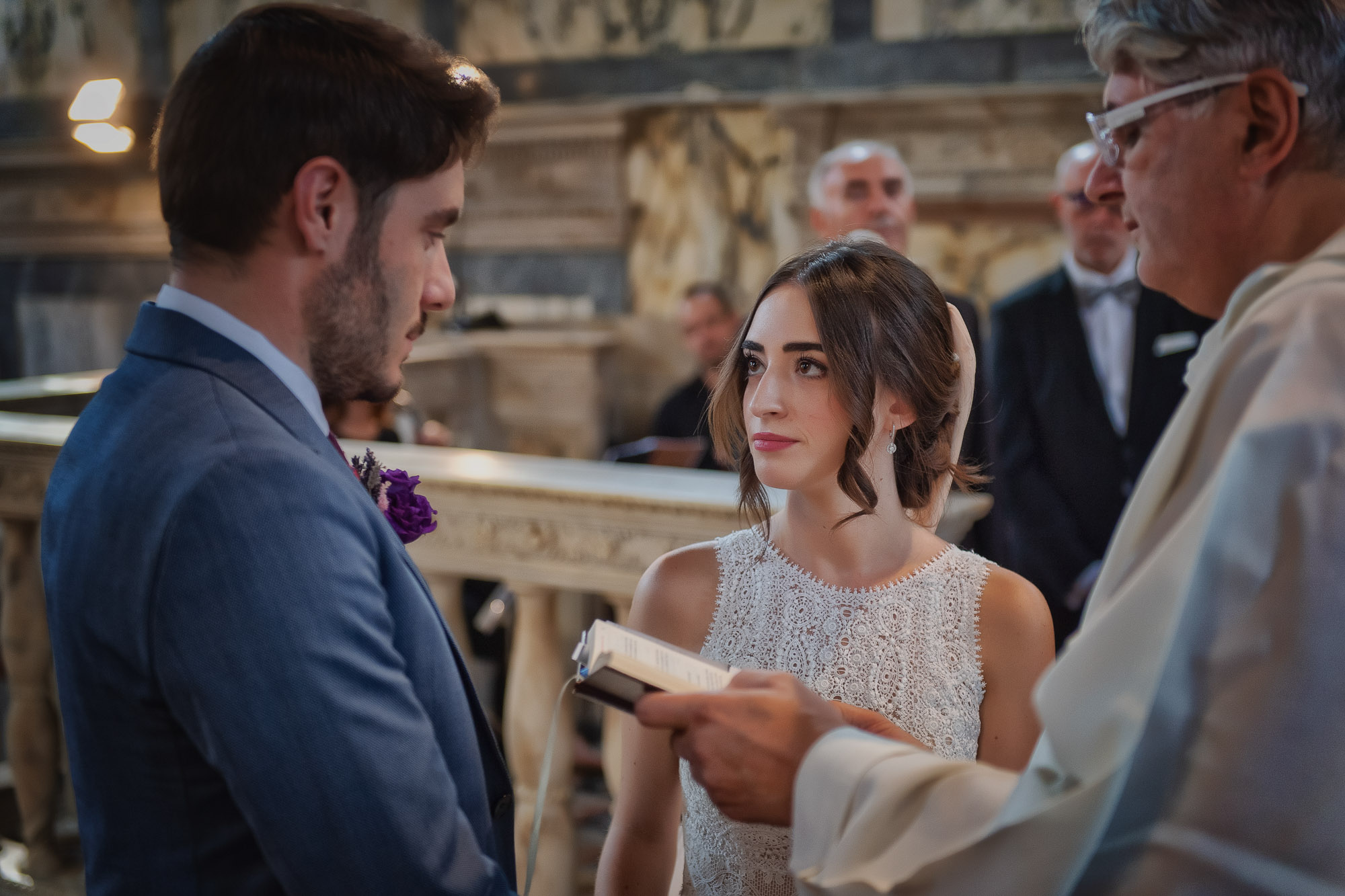
Protestant Ceremonies in Venice

San Giorgio dei Greci
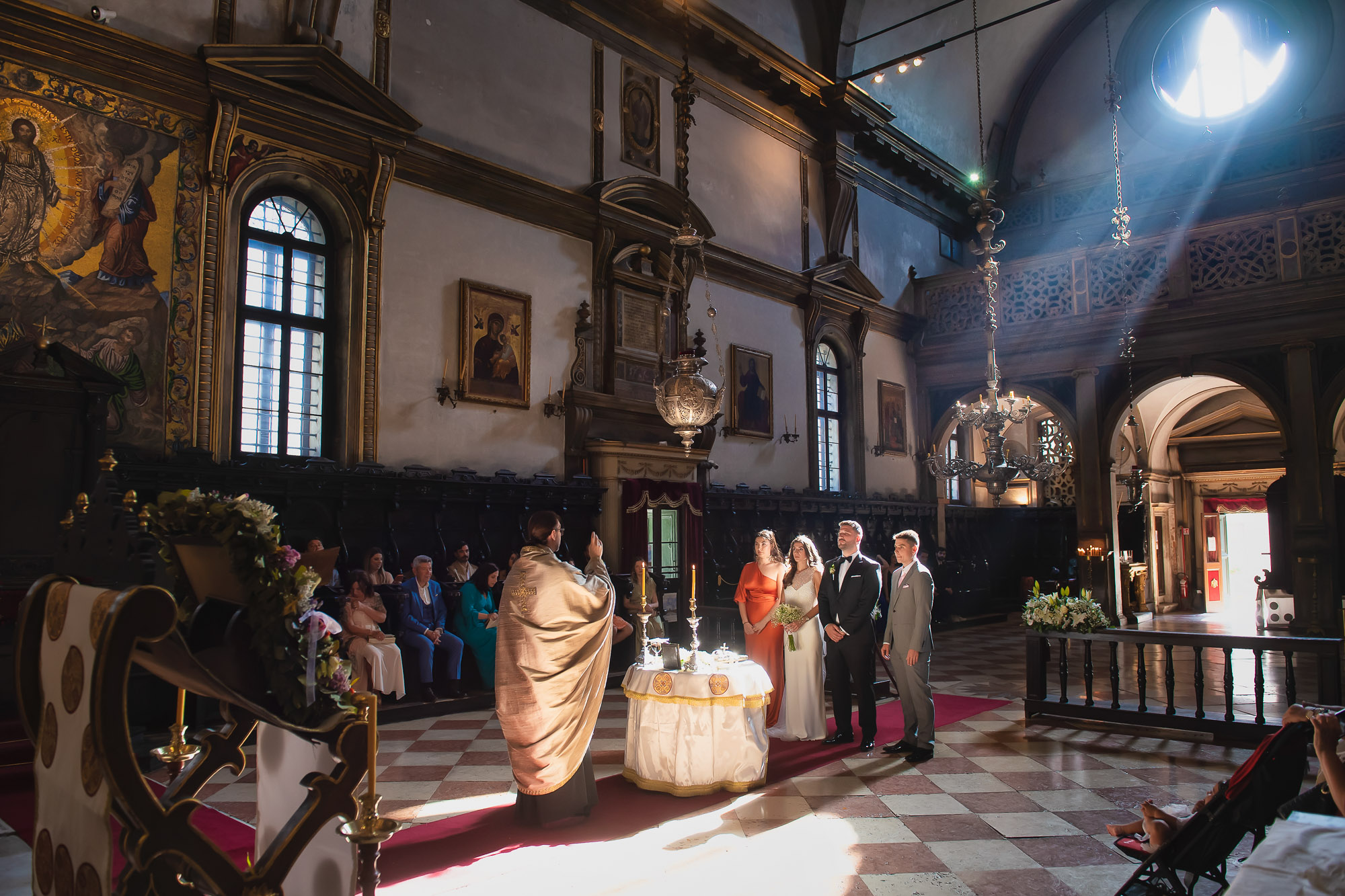
The historic center of the Greek Orthodox community in Venice, San Giorgio dei Greci offers an interior that is intimate, richly decorated, and governed by a controlled lateral light that changes significantly depending on the time of the ceremony. Photography here requires precision at every stage of the rite, from the entrance to the crowning and the final procession, and a deep respect for the Orthodox liturgical tradition. I have worked in this church across multiple ceremonies and know its spatial logic completely.
Santa Maria dei Miracoli
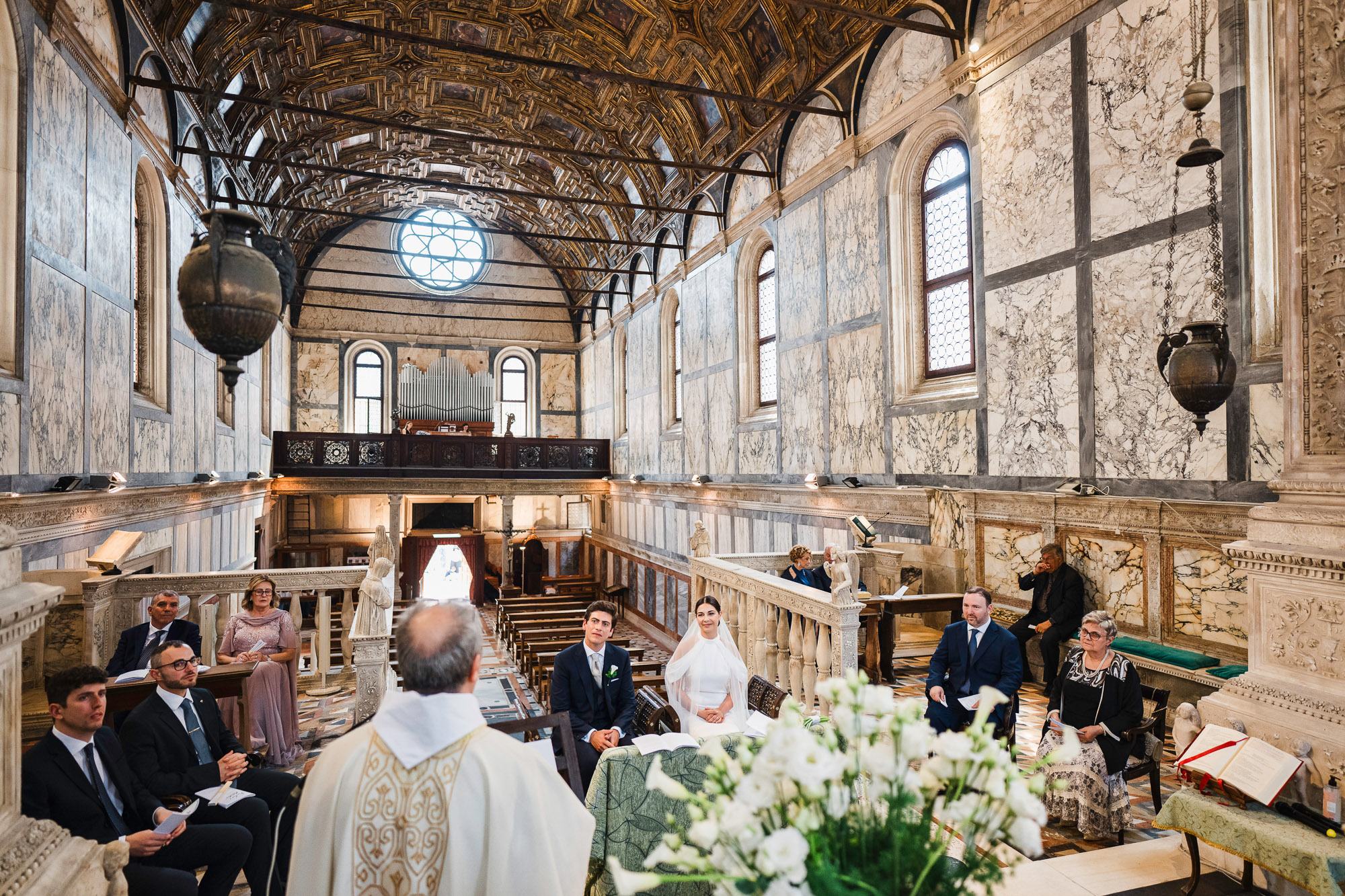
One of the most architecturally refined spaces available for a Catholic wedding in Venice, Santa Maria dei Miracoli is a jewel-like Renaissance church with marble interiors and a compact, vertical layout. Light enters softly but in limited quantity, making technical control and advance preparation essential. Movement is restricted by both the architecture and the officiant’s rules. The visual quality of this church rewards the photographer who knows how to work within its limits rather than against them.
San Giglio (Santa Maria Zobenigo)
A Baroque church with pronounced verticality and richly sculpted interiors, San Giglio offers light conditions that vary significantly depending on the time of day and the season. The sightlines from the permitted shooting positions are specific to the church’s layout, and the transition from exterior to interior light requires immediate technical adjustment on arrival. Knowledge of this church’s spatial structure is a prerequisite for consistent results during the ceremony.
Basilica dei Frari
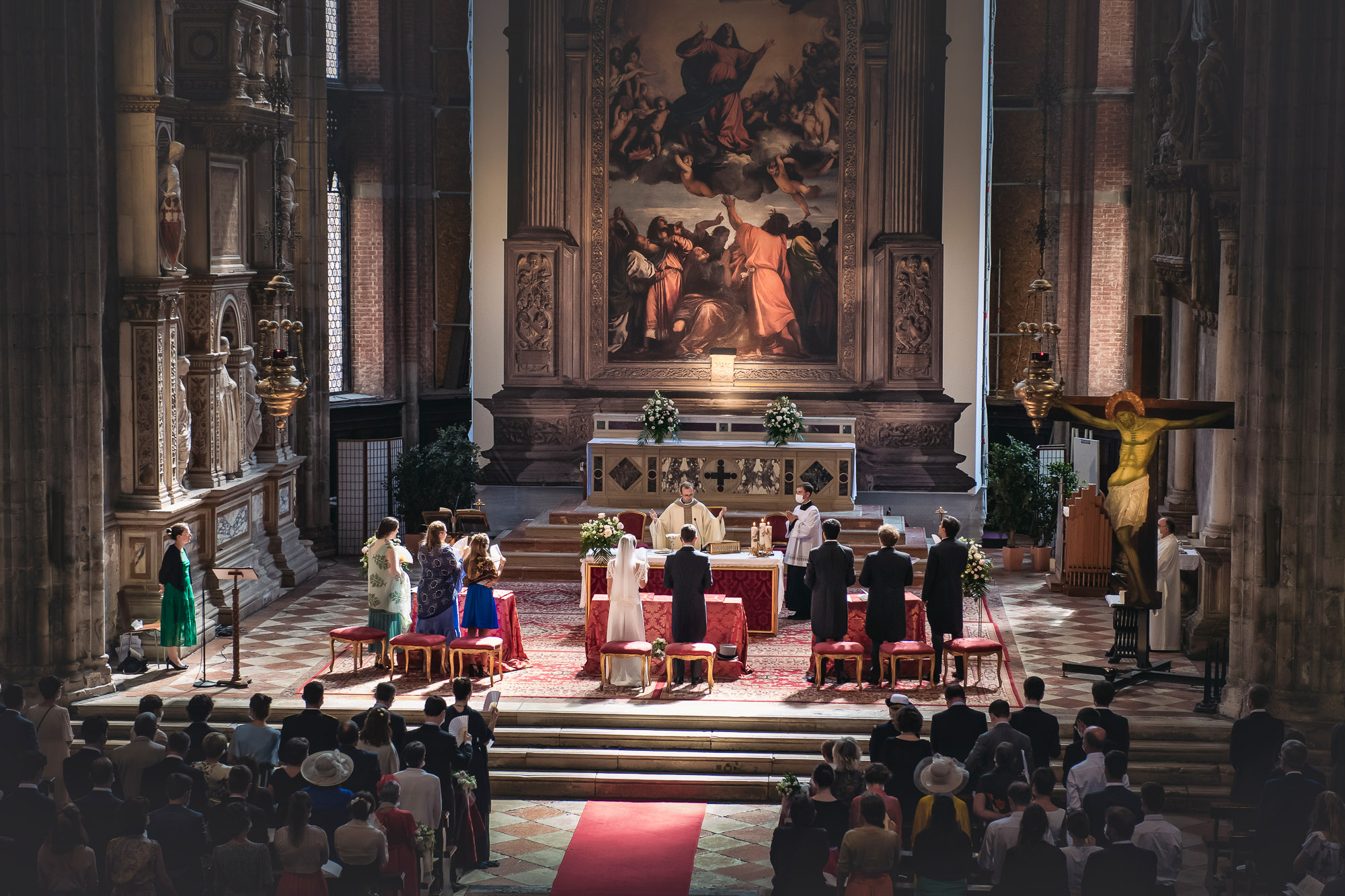
One of the largest and most important churches in Venice, the Basilica dei Frari presents religious wedding photography challenges proportional to its scale. The long aisles, the complex multi-source lighting conditions, and the distance between the permitted shooting positions and the altar all require silent long focal length lenses, a thorough understanding of the church’s interior geography, and the ability to anticipate key liturgical moments from a significant distance without losing visual coherence.
San Lazzaro degli Armeni
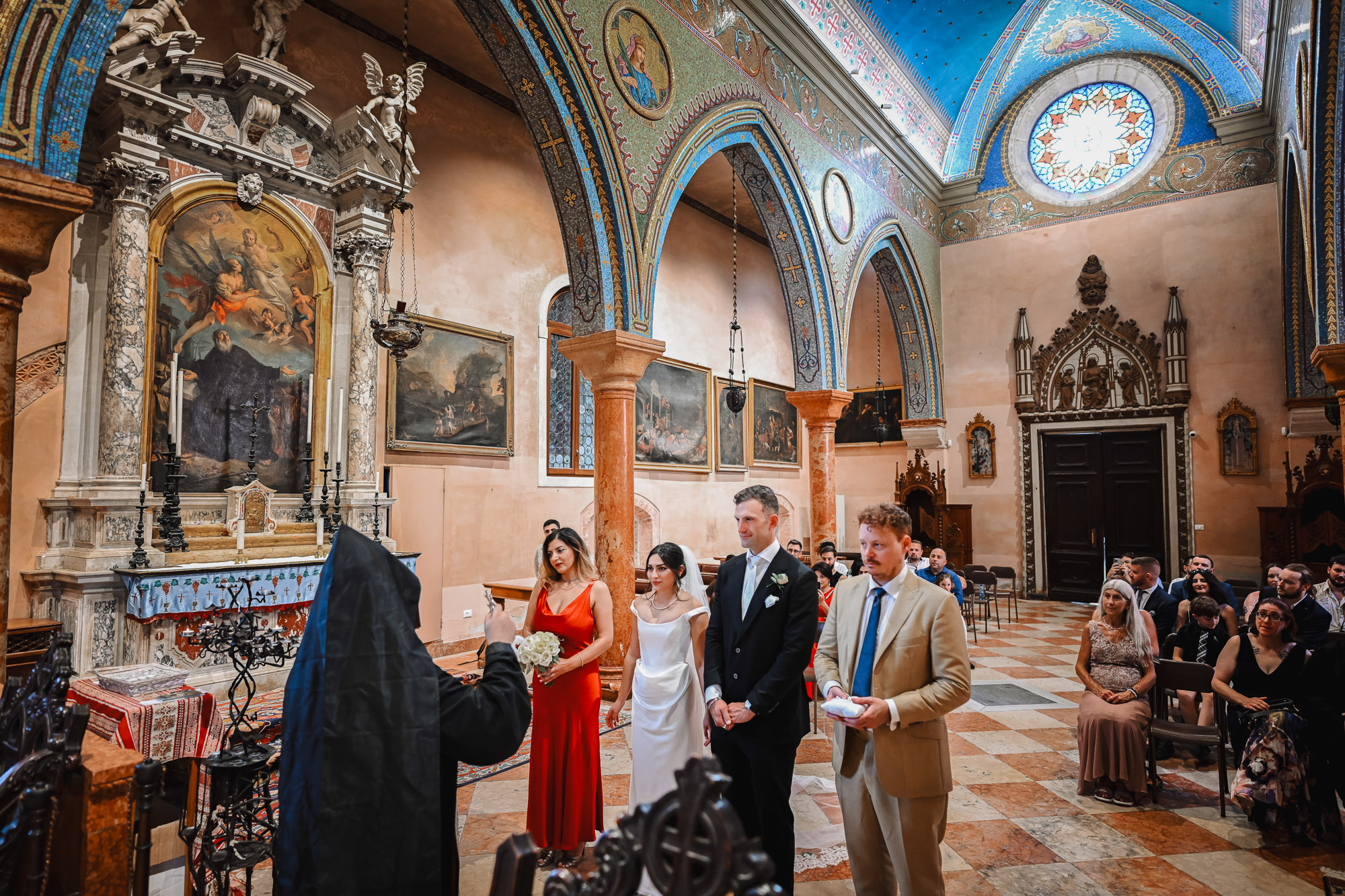
Located on its own island in the Venice lagoon, the Armenian monastery of San Lazzaro hosts some of the most solemn and visually distinctive religious ceremonies available in Venice. Access requires advance coordination with the monastery administration, and the logistical complexity of an island ceremony demands a level of planning that goes well beyond the photographic preparation itself. The ceremony is structured, deeply ritualized, and photographically unlike anything else in the city.

A religious wedding ceremony is not a performance, and the photographer’s role is not to direct it. My approach is built entirely around observation, anticipation, and documentation without intrusion. I move minimally during the ceremony. I work exclusively with available light in churches where flash is forbidden, and with controlled minimal flash only where the officiant explicitly permits it. I use silent equipment that does not register acoustically within the space.
What this produces is not a series of constructed images. It is an honest visual record of one of the most significant moments in a couple’s life, documented with the same discretion and precision that the sacred space itself requires. The church imposes a discipline on the photographer that I consider a gift rather than a constraint. It removes everything that is unnecessary and leaves only what is genuinely true.
Before every religious wedding ceremony in Venice that I photograph, I visit the church during its regular opening hours to review the light conditions, identify the permitted positions, and confirm the sequence of the rite with the officiant or the planner. Nothing about my presence on the day of the ceremony is improvised.

Religious wedding photography in Venice extends well beyond the ceremony itself, and the moments before and after the rite are often among the most photographically powerful of the day. Before the ceremony begins, the arrival of guests creates a particular quality of collective anticipation inside the church that is worth documenting: the light filling the nave, the congregation finding its place, the final preparations at the altar. Outside the church, the arrival of the couple and the entrance are transitional moments that carry significant emotional weight.
After the ceremony, the exit from the church into the surrounding campo or calle is frequently the most spontaneous and joyful sequence of the entire day. The couple emerges into the Venetian light for the first time as a formally united pair, surrounded by guests who have just shared a sacred space with them. This is the moment when the city visually receives the ceremony and makes it part of its own continuous history.
Short portrait sessions in the streets and canals immediately surrounding the church follow naturally from this moment. The church wedding photography context gives these exterior portraits a specific gravity that generic location sessions do not carry. The architecture, the light, and the emotional state of the couple after the ceremony create images that could only exist in this precise sequence.
A religious ceremony in Venice represents one part of a complete celebration. When combined with preparation, portraits in the city, a reception, or additional locations across the lagoon, the overall structure of the day requires a broader photographic strategy that goes beyond the church itself. The preparation, the transfer by water taxi or gondola, the ceremony, the exit, the portraits, and the reception each have their own light conditions, their own emotional register, and their own photographic demands.
The complete approach to documenting full celebration days in Venice, including how the religious ceremony integrates with every other part of the day, is covered in detail on the complete wedding photography in Venice page.

Administrative preparation for a Catholic wedding in Venice requires time and precision. The Diocese of Venice requires baptism and confirmation certificates from both partners, documented proof of premarital preparation completed in the couple’s home parish, formal authorization from that parish, and a final approval granted by the Venetian Diocese itself. This process involves multiple institutions across different countries for international couples and typically takes a minimum of six to twelve months to complete.
For Greek Orthodox and Armenian Apostolic ceremonies, the requirements are governed by the respective community churches in Venice and vary in their administrative structure. What all rites share is the need for early initiation of the process. Beginning the administrative preparation at least a year before the intended date is strongly recommended for any religious wedding in Venice.
From a photographic perspective, the earlier I am informed of the chosen church and the confirmed date, the more effectively I can prepare the specific visual strategy for that space and that rite. Early communication between the couple, their planner, and the photographer is one of the most practical contributions to the quality of the final images.